Don’t Chase the Hot Ticket
John Mah - Apr 22, 2026
Chasing what’s “hot” in markets often leads investors to overpay and arrive late to the opportunity. Diversified portfolios grounded in discipline and long‑term thinking, help clients stay invested and build wealth more reliably over time.
Key Takeaways
-
What’s popular today often looks obvious in hindsight, but by then, much of the opportunity is already gone.
-
Market leadership constantly changes, which is why diversification across sectors, company sizes, and regions matters.
-
A disciplined, diversified approach helps investors stay invested, avoid costly behaviour, and build wealth over time.
Last March, my partner surprised me with Blue Jays tickets. It had been years since I’d been to a game, even though I still considered myself a fan. The Jays had just won the Grapefruit League and were playing an AL East rival, the Baltimore Orioles. On paper, it looked promising.
In 2024, Jays underperformed, and even though Spring Training offered some hope, the stadium was half full, and getting food was easy. I happily crushed a foot‑long hot dog and a Diet Coke before first pitch, while Linda chose something far healthier. We were settled comfortably in our seats (and had already spent $60 on snacks) well before the game began.
Fast forward to September 6, 2025.
Back at the Dome, everything had changed. The Jays were contenders, fighting for a playoff spot, and the opponent was the Yankees. The building was electric and packed. Security lines stretched endlessly, concession lines were hopeless, and despite arriving 45 minutes early, I started the game hungry. Success, it turns out, attracts crowds.
The reason we were there that night deserves its own story.
Back in early spring, long before the Jays showed any real signs of life, Linda quietly planned a surprise. She spoke with my brother, a serious Jays fan, who suggested getting Yankees or Red Sox tickets later in the season. Acting on that advice, she bought Jays‑Yankees tickets in April, when excitement was low and demand was minimal.
By September, those seats had become some of the hottest tickets in town.
During the game, we chatted with our seat neighbours. Someone asked what we paid. Linda casually mentioned how easy it was to get the tickets back in April. The response was immediate: our neighbour had paid $450 per seat on the resale market. Linda looked at me and said, “I wouldn’t pay that for a baseball game.”
Smart call.
The Jays lost that night – a small disappointment. But the experience delivered a powerful reminder that applies far beyond baseball.
Investors Behave Like Sports Fans
The better the team (or the hotter the stock), the more people want in. Whether it’s dot‑com stocks, cannabis, crypto, the Magnificent Seven, or gold, the pattern is the same. When something is working, human nature pulls us toward it. FOMO is real – and persistent.
History offers no shortage of examples.
In the late 1990s, technology stocks surged alongside the rise of the internet. Between 1995 and March 2000, the NASDAQ gained over 400%. Capital flooded into tech funds near the peak. When the bubble burst, the index lost nearly 80% between 2000 and 2002, and many once‑popular companies never recovered. Investors didn’t buy value, they bought excitement.
The cycle repeated in 2020–2021. Ultra‑low interest rates fuelled sharp gains in growth stocks and speculative themes. Funds with the strongest trailing returns attracted the most money late in the cycle. When inflation and rates rose in 2022, many former leaders declined 50–80%. Leadership changed quickly and painfully.
Crypto markets compress this lesson into even shorter timeframes. Bitcoin surged from under $1,000 in early 2017 to nearly $20,000 by year end, only to fall more than 80% the following year. The same pattern played out again from 2020–2022. Investors who arrived late experienced severe drawdowns; many speculative tokens disappeared entirely.
Why Diversification Actually Matters
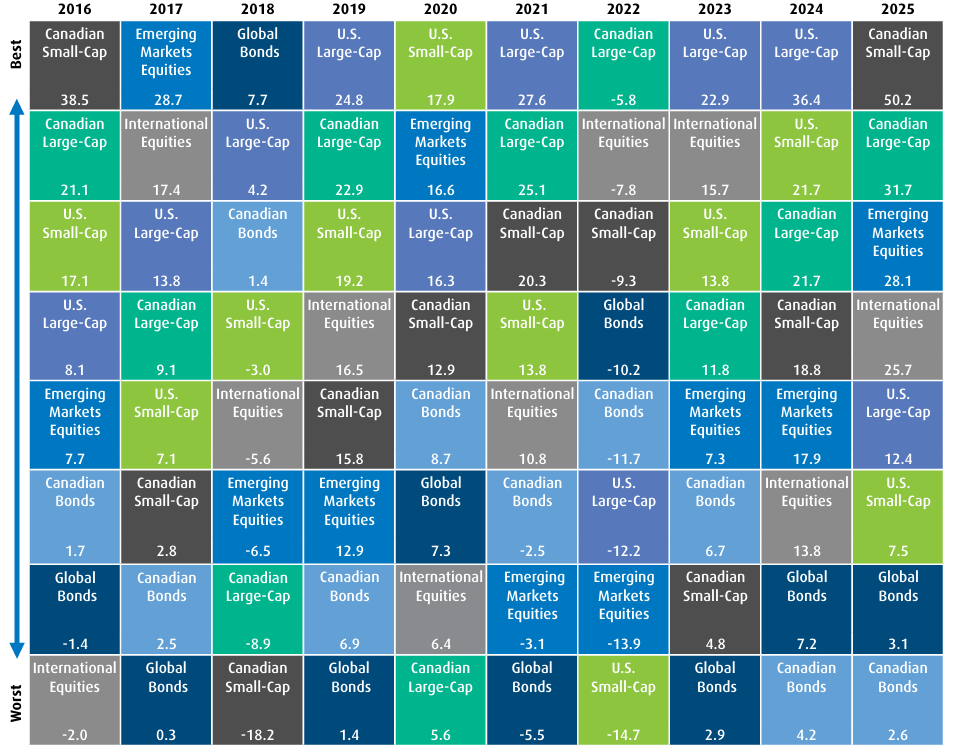
If you look at the Periodic Table of Asset Class Returns**, one thing jumps out right away: leadership never stays put. Canadian stocks shine one year, U.S. stocks take over the next, then maybe it’s small‑caps, emerging markets, or even bonds having their moment. The winners and losers change constantly, often when no one expects it.
That’s exactly why we build portfolios that are diversified across asset classes, sectors, company sizes, and geographies. Rather than trying to guess which market or theme will be “the ticket” this year, we focus on balance and discipline. At the Mah Investment Group, we believe a well‑diversified portfolio gives clients a better chance of participating when leadership rotates, while avoiding the regret that comes from piling into yesterday’s winner.
Diversification isn’t about avoiding risk altogether. It’s about managing it thoughtfully, staying invested through different market cycles, and positioning portfolios to compound steadily over time, even when the headlines (or the crowd) are chasing something else.
The Takeaway
Exceptional recent returns usually coincide with elevated expectations and stretched valuations. By the time an opportunity looks obvious, much of the upside has already been captured, just like buying Yankees tickets after the Jays become contenders.
A more durable investment approach focuses on diversification, valuation discipline, and regular rebalancing, aligned with long‑term objectives. Chasing what’s hot may feel like momentum, but more often it leads investors to buy high, sell low, and repeat the cycle at great cost.
Sometimes, the best results come from buying the tickets before the crowd shows up, and enjoying the game for what it is.
**The Periodic Table of Asset Class Returns shows the annual returns of various asset classes, as measured by its appropriate global market index,1 and ranks them in order of performance – from best to worst – from 2016 to 2025 (in CDN$)