Cash Gab with Noah - September 2026
Noah Ross - Sep 01, 2026
In this issue, we’ll be covering the power of the buy and hold approach (to good investments), the blurring lines between gambling and investing, and some updates in the news.
Quick Nugget of the Day
“Time in the market beats timing the market”
It’s easy to get caught up in headlines and let fear (and greed) drive investment decisions. That’s human nature. Take a look at these charts I pulled on August 21st, 2026:
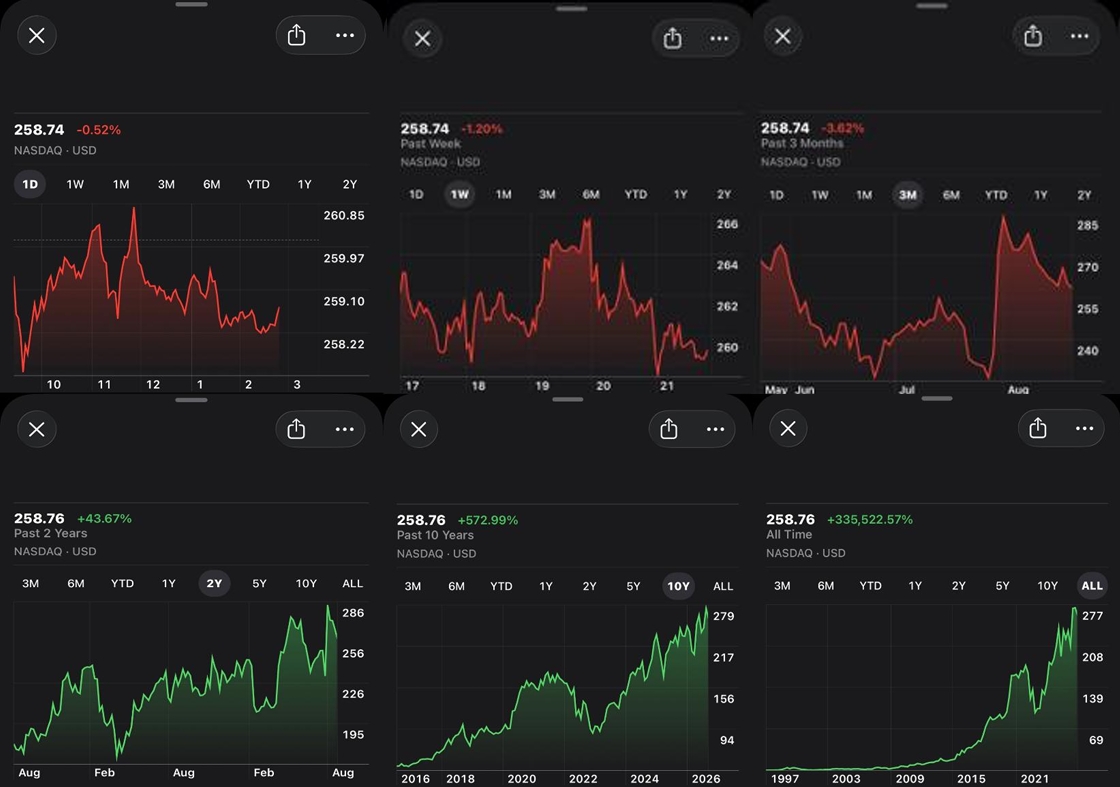
On the 1-day, 1-week, and even 3-month view, this company doesn’t look very attractive. The stock is down, volatility is front and center, and many investors would be tempted to walk away or put their money elsewhere.
Now zooming out:
- 2 years is up +43%
- 10 years is up a staggering +572%
- Since inception is up a remarkable +335,000%
This is the same company but a different timeframe.
One of the challenges of investing is that the more often we check our portfolios, the more often we experience the emotional sting of short-term declines or the highs of short-term momentum. Yet, great businesses rarely move in a straight line.
Long-term wealth is built by staying invested through periods of red and allowing compounding to do its work as long as you’re invested in a diverse portfolio of strong companies with strong management and an enduring business. And in case you’re wondering, the company in these charts is Amazon.
The biggest investing mistakes often happen we focus on the next few days instead of the next few decades.
The Blurring Lines Between Gambling and Investing
Thank you to Tyler R. for sending the question on sports betting that inspired this article.
A recent online survey of 1,000 U.S. retail investors published by Bettermentfound that more than one-quarter of Gen Z investors view sports betting as a deliberate and ongoing part of their long-term financial strategy. Even more concerning, 52% reported redirecting money that otherwise would have been invested into sports betting, compared to 31% (still quite high) of millennials, 10% of Gen X, and 4% of baby boomers.
This trend reflects just how mainstream sports betting has become. In the United States alone, sports betting revenue has grown from roughly $400 million in 2018 to $17 billion in 2026.
Research suggests that only 3-5% of sports bettors are profitable over the long-term. In other words, at least 95 of every100 bettors lose money when measured over a year or longer. When a growing number of young people begin viewing sports betting as part of a long-term financial plan, that statistic becomes very troubling.
Ten years ago, sports betting advertisements were rate. Today, they’re impossible to ignore. When watching a Maple Leafs or Blue Jays game, I’m finding it increasingly difficult to find TV commercials or digital and stadium advertisements that aren’t connected to gambling in some way.
So why are younger generations increasingly turning to sports betting?
Part of the answer may be growing disillusionment with the financial system. Gen Z has faced rising housing costs, higher living expenses, a difficult job market, and increasing uncertainty about the future. At the same time, technological advancements such as AI are creating anxiety around entry-level career opportunities.
Combine that frustration with an explosion of betting platforms and a culture built around immediate gratification, and it's easy to see why gambling is becoming more appealing.
More Ways to Gamble Than Ever Before
There is no shortage of sports gambling platforms competing for attention:
- DraftKings
- FanDuel
- Bet365
- BetMGM
- theScore Bet
- Bet99
- Sports Interaction
- And many others…
These companies spend enormous sums on advertising, promotions, and incentives designed to acquire and retain users. But sports betting is only part of the story.
Today, people can wager not only on sports and casino games, but increasingly on prediction markets tied to economic events, financial markets, political outcomes, and other real-world developments with Wealthsimple recently getting approval to offer this on their platform. Calling these products “prediction markets” may sound more sophisticated, but they are fundamentally another form of betting on future outcomes.
When products like these begin appearing on platforms like Wealthsimple that are primarily associated with investing, the distinction between gambling and investing becomes increasingly blurred.
And this trend may continue. In the US, proposals have even emerged for ETFs tied to NHL team performance through future-based exposure. While not currently available, products like these highlight how financial markets and gambling are moving closer together.
The Culture of Immediate Gratification
Last year, I wrote about the Financial Costs of Becoming Accustomed to Immediate Gratification.
We live in a world where most things are available instantly. Food from our favourite restaurant arrives at our door with a few taps on a screen. Packages show up the next day. Social media provides an endless stream of entertainment and dopamine hits. And rather than walking to Blockbuster to rent a movie to watch that weekend, we have access to nearly every TV show and movie at our fingertips. After many years with this reality, we’re now conditioned to expect immediate results.
Investing doesn’t work that way.
Building wealth usually requires patience, discipline, and time. Gambling, by contrast, offers instant feedback. The outcome is known within minutes, hours, or days.
For a generation feeing pressure to get ahead, that can be very appealing.
The danger is that the emotional reward of gambling can be powerful. A winning bet provides immediate excitement and reinforcement of the behaviour, even when long-term odds are stacked against the bettor. That’s a big reason why gambling addiction continues to be a serious issue.
I don't personally participate in sports betting, although I have many friends who enjoy it recreationally. For those who set limits and treat it strictly as entertainment, that's their choice.
What concerns me most is not casual betting. It's the growing number of young investors who are treating gambling as a legitimate strategy for building wealth.
That's a dangerous proposition when more than 95% of long-term sports bettors lose money.
The irony is that young people already possess the most valuable asset in investing: time. Through consistent contributions to diversified, long-term investments, wealth accumulation is more accessible today than at any point in history.
That path may not be as exciting as a winning bet, but it offers something sports gambling almost never does:
A realistic probability of long-term success.
In the News
Over half of Canadians report behaviours that increase fraud vulnerability – BNN Bloomberg
Despite 89% of Canadians feeling confident they can spot fraud, more than half admit to behaviours that increase their risk, such as using public Wi‑Fi for financial activities, clicking unverified links, and opening attachments from unknown sources.
With nearly half of Canadians encountering scam or fraud attempts weekly, staying vigilant is essential, regardless of how confident you feel in your ability to recognize them. Check out BMO’s security checklist.
Bank of Canada expected to hold rates steady as trade war escalates – The Globe and Mail
The Bank of Canada is expected to keep its benchmark interest rate unchanged at 2.25% as it weighs the economic impact of the escalating trade tensions between Canada and the U.S. New tariffs and planned counter tariffs could push consumer prices higher, adding to inflationary concerns, but they also risk slowing economic growth by reducing exports.
With uncertainty on how this will play out, economists believe the central bank’s most prudent course of action at this juncture is to remain on hold and assess how trade negotiations unfold in the months ahead.
The Ross Group: Who We Are

At Ross Group Wealth Advisors, we work with future-minded investors to keep them on track toward greater wealth. Through our unique approach to portfolio management and wealth planning, we deliver smart risk and tax strategies and guide sound decisions that secure their wealth and expand their lives.
What We Provide
We act as your financial quarterback, building comprehensive, long-term strategies, not quick fixes. Our wealth plans aim to minimize taxes and safeguard your financial health today and for the future.
We proactively review your portfolio and overall financial picture, update your wealth plan regularly, and ensure you stay aligned with your goals. We engage with your priorities, uncover opportunities, and challenge assumptions about what you can do and when.
Community Engagement
Join the wait list for an in-person Cash Gab Session:
What is a Cash Gab Session?
Cash Gab brings together peers in similar careers and life stages to share, listen, and learn about financial topics that matter to you. The goal is to build a community of like-minded, future-oriented people aiming to achieve financial freedom.