Cash Gab with Noah - April 2026
Noah Ross - Apr 01, 2026
Given volatility in the markets right now, the focus of this issue will be around managing volatility: of investments, careers, and more.
Quick Nugget of the Day
Dollar Cost Averaging
Dollar cost averaging means investing a fixed amount on a regular schedule, regardless of market conditions. It removes the pressure to time the market and replaces it with consistency.
Why It Works
Behavioural Benefit
Automating contributions builds the habit of paying yourself first. Smaller, regular investments are easier to stick with than waiting to invest a large lump sum, which often ends up sitting in cash or getting spent instead.
Psychological benefit
Market volatility becomes less stressful. When markets are down, you’re buying more at lower prices (a sale!). When marketsare up, you’re still participating. It removes the temptation to time the market, which is usually just emotion dressed up asstrategy.
Monetary benefit
By investing consistently, you naturally buy more when prices are low and less when prices are high. Over time, this often leads to better long‑term outcomes than sporadic or reactive investing.
Dollar Cost Averaging in Action
I modeled investing $500 per month in 2011 into both the S&P 500 and the TSX (for ease of accessing performance numbers), increasing monthly contributions by $25 each year. By 2025, monthly contributions reached $850 per index, invested consistently through every market environment: COVID, wars, tariffs, and through sustained periods of growth.
The result by end of 2025:
- Total contribution: $243,000
- Portfolio value: Over $543,000
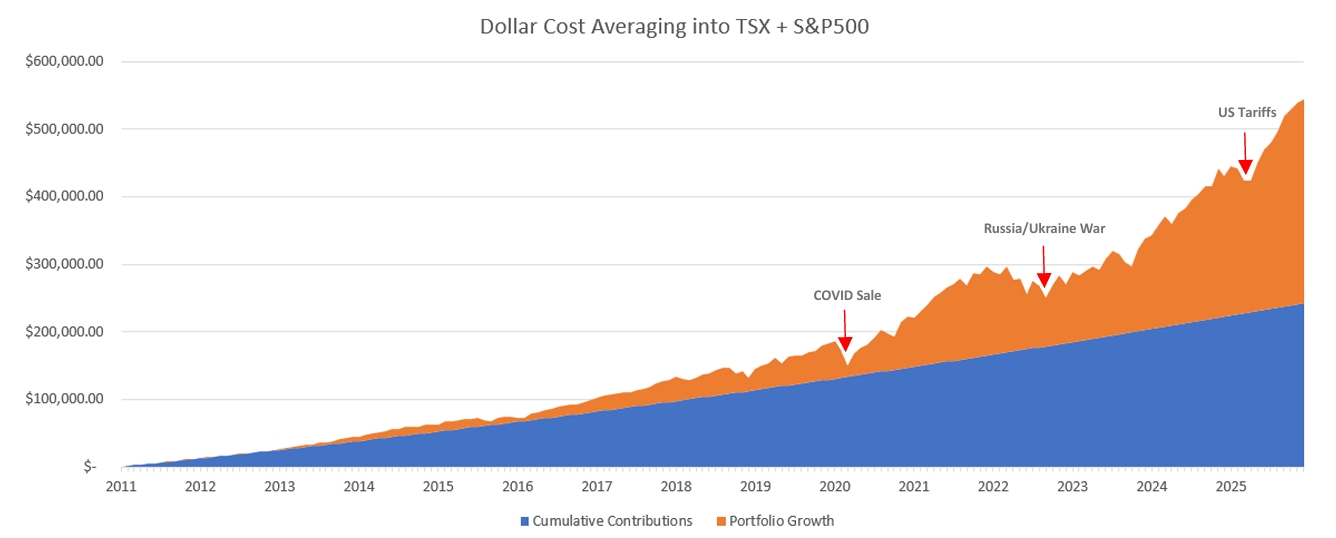
Consistent saving adds up faster than most people realize, especially when contributions increase over time. Staying invested and continuing to add through all markets can lead to powerful long-term outcomes.
The Lottery Question
What would it really be like to win the lottery?
My father Larry and I are writing a book that challenges the traditional idea of retirement and how we spend our time.
One chapter will center on how answering our Lottery Question can help people gain the benefits without needing to win.
Instead of asking what you would spend the money on, we ask: “If you won the lottery tomorrow, how would change the way you spend your TIME?”
We’re running a short survey to gather responses for the book and would appreciate a few minutes of your input. As part of the next issue of the newsletter, I will include an extended Lottery Question worksheet to take this exercise one step further.
Thank you for contributing to the research.
AI, Tech Layoffs, and the Financial Realities Many People Are Facing
Artificial intelligence is here, and it is changing how companies operate, how work gets done, and how roles are valued.
Over the past year, we have seen large technology companies announce significant layoffs, with AI frequently cited as a driver. In many cases, the narrative is not that companies are struggling, but that they are becoming more efficient. Fewer people can now do work that once required much larger teams.
For people who have spent years building careers in tech, especially at one company, this environment can be both exciting and frightening. Highly capable, high performing professionals are exposed to more pronounced financial risks.
During periods of change like this, there are a few financial realities worth keeping in mind.
1. Income Risk Is Real, Even for Highly Paid Professionals
One of the biggest risks during widespread layoffs is not just losing a job but losing options. When many companies are reducing headcount at the same time, the ability to quickly replace income can become harder, even for people with strong resumes and in-demand skills.
Yes, large tech companies often provide severance packages. These can be meaningful and helpful. But severance is temporary by design. It is meant to bridge a short gap, not guarantee stability. This is where having a dedicated emergency fund matter.
An emergency fund is not about pessimism. It’s about flexibility. Having readily accessible cash gives you:
- Time to be selective rather than reactive
- The ability to wait for the right role, not just the first offer
- Protection if severance runs out before income resumes
In times of rapid change, having some money in the bank (6-12 months expenses) is not conservative. It’s strategic. If you do not have an emergency fund today, the best time to start building one is now, even if it starts small.
2. Group Benefits Do Not Follow You
Another overlooked risk during job transitions is the loss of group benefits. Health insurance, dental coverage, life insurance, and disability insurance are often tied directly to employment. When employment ends, those benefits usually do as well.
For people with families, dependents, or ongoing health needs, this can create both financial and emotional stress, especially if there is a gap before benefits resume at a new employer.
This is another reason why liquidity matters. Having cash available allows you to:
- Cover private insurance premiums if needed
- Pay out of pocket expenses temporarily
- Avoid making rushed decisions under pressure
This also highlights the value of having personally owned insurance coverage (life insurance, disability, critical illness). Understanding what coverage you have, what you lose if employment changes, and how long you could self fund gaps is an important part of planning.
3. Concentration Risk in Both Income and Net Worth
Many people working in tech face a unique form of risk: concentration. Your income often comes from one company. At the same time, a significant portion of your net worth may also be tied to that same company through stock options, RSUs, or equity grants.
Over the last few years, many tech and AI related companies have seen their valuations rise dramatically. Companies building AI, enabling AI, or deploying it effectively have rewarded employees with equity that is now worth far more than originally expected. That’s a good problem to have. But it’s still a problem unmanaged. Concentration risk shows up in two ways:
- Your paycheck depends on one employer
- Your wealth depends on one stock
If that company stumbles, restructures, or changes direction, both your income and your net worth can be impacted at the same time. Two things often stop people from reducing this risk:
- Taxes. Selling equity can trigger meaningful tax consequences.
- Optimism. The belief that the stock will keep going up forever.
Many people have become very wealthy on paper as their equity has grown. The harder question is how to turn that paper wealth into durable, diversified wealth.
For People with Significant (Multi-Millions) Single Stock Holdings: Collars and Monetization
One strategy that can be used in certain situations to manage a large, multi-million-dollar concentrated stock position is a collar. At a high level, a collar is an options strategy that puts guardrails around a stock you already own. It typically involves two components:
- Buying a put option, which sets a floor on how much the stock can fall
- Selling a call option, which sets a ceiling on how much upside you are willing to give up
The premium from selling the call often helps offset the cost of the put. The result is a defined range of outcomes rather than being fully exposed to whatever the market decides to do next. But protection is only part of the story.
For publicly traded shares, once a position is properly hedged with a collar, it may also be possible to borrow against the shares. You still own the stock. There is no sale, and no immediate tax triggered. The shares are simply used as collateral.
This can allow you to:
- Access liquidity without selling
- Reduce concentration risk
- Begin diversifying your net worth
The borrowed funds can then be invested into a diversified portfolio, spreading risk across different companies, sectors, and asset classes rather than relying so heavily on a single stock. An added benefit is tax control.
Because the shares are not sold, capital gains taxes are deferred for the life of the collar and loan arrangement. This creates flexibility. You can decide later whether it makes sense to sell the shares and realize the tax, rather than being forced into a decision by market volatility or a change in employment.
This type of strategy is not about avoiding taxes forever or trying to outsmart the system. It’s about turning a concentrated position into something more balanced, while choosing when and how taxes are paid.
Like all advanced planning strategies, collars and monetization need to be evaluated carefully and implemented thoughtfully. They are not right for everyone. But for individuals who have built significant wealth through equity compensation, they can be a practical way to move from being wealthy on paper to having a more resilient and flexible financial picture.
In the News
Market Outlook: Volatility creates buying opportunity in U.S. stocks – BNN Bloomberg
Since the war in Iran began, markets have been volatile, particularly in the U.S. Each day brings new headlines and updates, and markets are reacting accordingly. The potential global economic impact is meaningful, especially in the short term with uncertainty around the Strait of Hormuz.
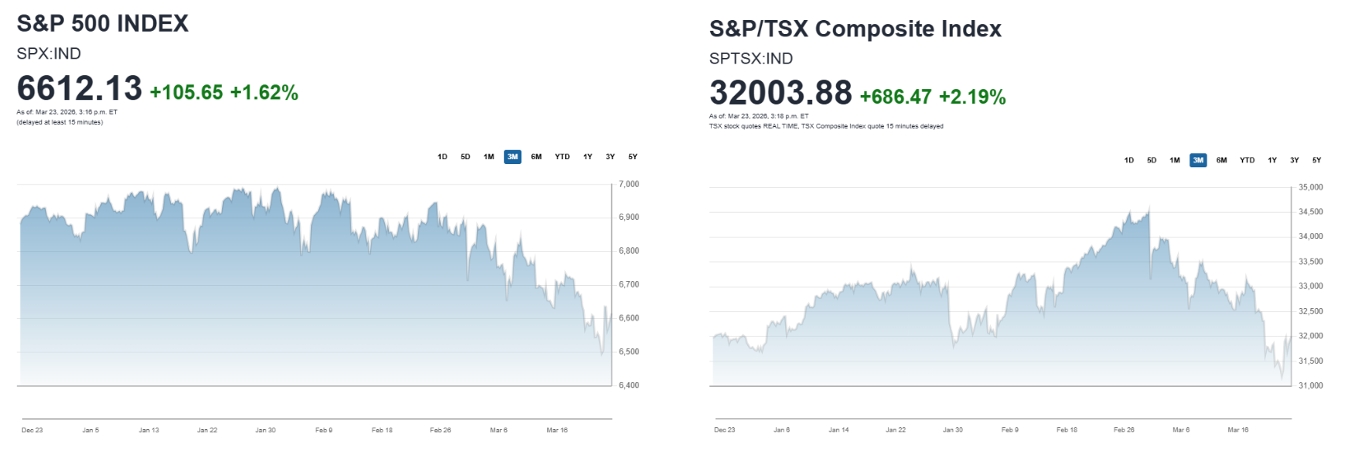
For long-term investors, volatility can also create opportunity. If you are dollar-cost averaging, as shown earlier in this newsletter, you are naturally taking advantage of the pullbacks we’ve seen across industries. Short-term uncertainty is weighing on prices and creating chances to buy at more attractive levels.
If you’re feeling anxious seeing portfolio values dip so far this year, remember that, like past market drawdowns, this too shall pass. We don’t know when. But for long-term capital invested in a well-diversified portfolios across companies, industries, and geographies, the most important thing is to stay disciplined and stick to the plan.
Bank of Canada Rate Decision – Preaching Patience – BMO Economics
The Bank of Canada held its policy rate at 2.25%, continuing its pause after last year’s rate cuts. According to Douglas Porter of BMO Economics, ongoing economic softness, a weaker labour market, and elevated global uncertainty make further moves unlikely in the near term. BMO’s view is that the bank is firmly in wait-and-see mode, with current rates sitting near neutral and doing their job without adding unnecessary pressure to the economy.
For investors and borrowers, this suggests a period of relative rate stability, where planning and discipline matter more than trying to anticipate the next policy move.
Cash Gab Book of the Month
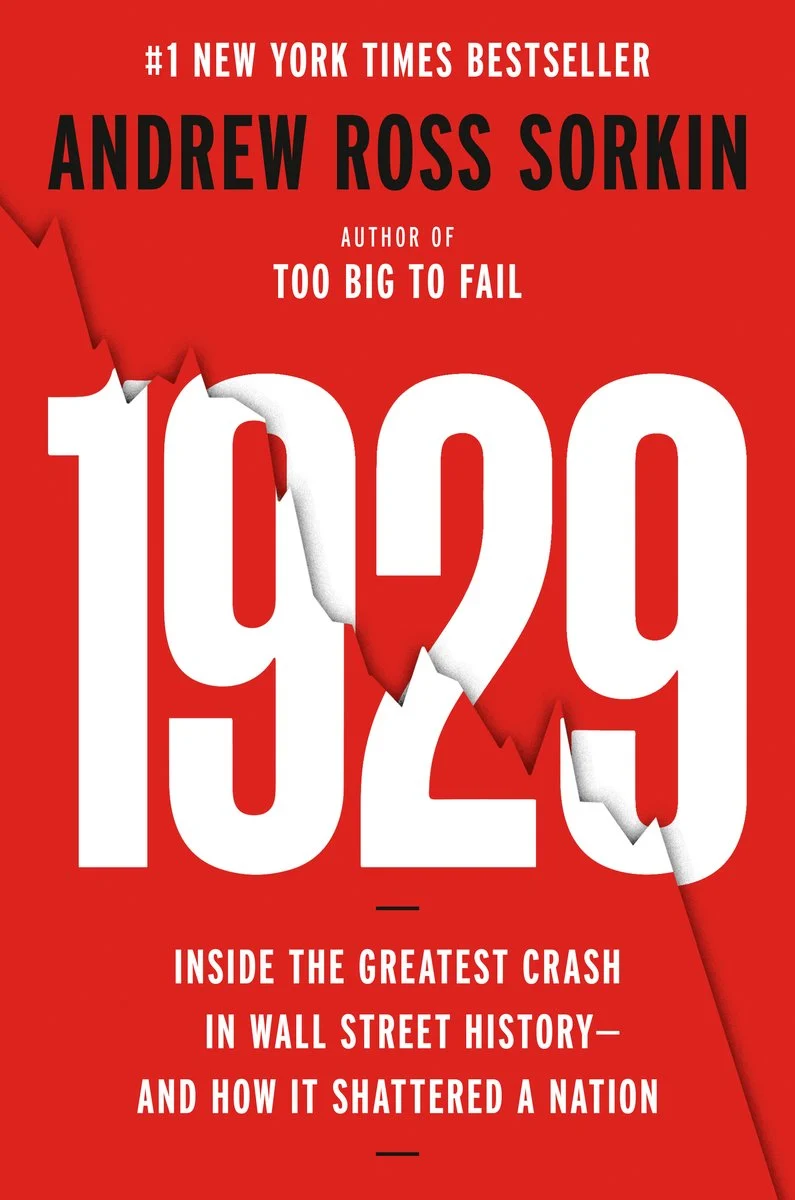
Book: 1929: Inside the Greatest Crash in Wall Street History – and How It Shattered a Nation
Author: Andrew Ross Sorkin
Summary: This is a narrative history of the Wall Street crash that reads more like a thriller than a textbook. The story unfolds through the eyes of bankers, speculators, politicians, regulators, and journalists whose incentives, decisions, and blind spots helped turn a booming, highly leveraged market into a historic collapse.
One passage near the end of the book stood out to me:
“No cities were bombed or torched in the fall of 1929, and no armies marched on Washington. There were no revolutions or attempted assassinations. No government buildings were taken over by angry mobs. The country faced no earthquakes or floods or fires or pandemics. All the factories remained standing. Most of the farms kept producing. Contrary to conventional wisdom, there was not even any significant loss of life. Popular accounts of despondent stock traders hurling themselves out of windows and leaping off rooftops painted an inaccurate picture… But daily life in America certainly felt different. To the nation, experiencing the implosion of the stock market felt like watching a heavyweight champion getting knocked out by an untested, unheralded amateur. It wasn’t the way the world was supposed to work…”
What the book captures so well is a universal truth about markets and human behavior. Financial decisions are often driven by fear and greed. The crash of 1929 remains one of the clearest reminders of how powerful, and how destructive, those forces can be.
The Ross Group: Who We Are

At Ross Group Wealth Advisors, we work with future-minded investors to keep them on track toward greater wealth. Through our unique approach to portfolio management and wealth planning, we deliver smart risk and tax strategies and guide sound decisions that secure their wealth and expand their lives.
What We Provide
We act as your financial quarterback, building comprehensive, long-term strategies, not quick fixes. Our wealth plans aim to minimize taxes and safeguard your financial health today and for the future.
We proactively review your portfolio and overall financial picture, update your wealth plan regularly, and ensure you stay aligned with your goals. We engage with your priorities, uncover opportunities, and challenge assumptions about what you can do and when.
Community Engagement
Join the wait list for an in-person Cash Gab Session:
What is a Cash Gab Session?
Cash Gab brings together peers in similar careers and life stages to share, listen, and learn about financial topics that matter to you. The goal is to build a community of like-minded, future-oriented people aiming to achieve financial freedom.