Cash Gab with Noah - January 2026
Noah Ross - Jan 01, 2026
There seems to always be buzz online about outsized returns from the latest “hot” investment or industry. While tempting, chasing high returns often means taking on unnecessary risk. This simple calculation shows you don’t need a 25% annual return...
Quick Nugget of the Day
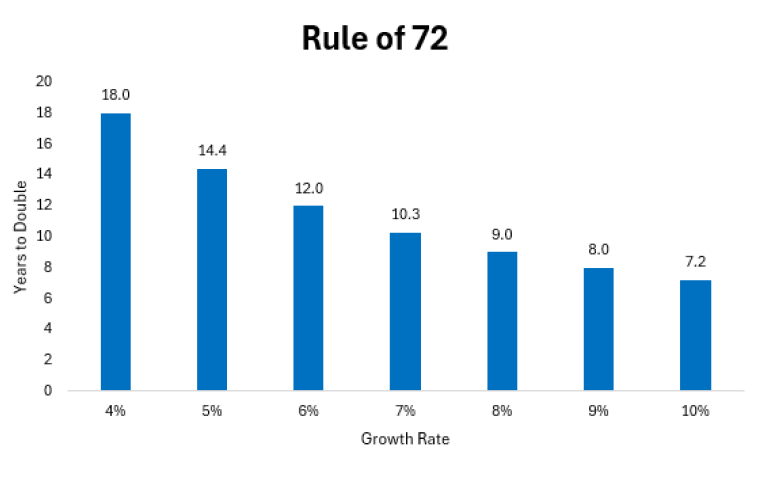
The Rule of 72: Divide 72 by your rate of return to estimate how long it will take at that rate for your money to double.
The Numbers
If your portfolio of investments returns 8% per year, it will take 72 / 8 = ~9 years for your money to double assuming no new money is added to your portfolio. Adding money to your investments each month will decrease the time to double significantly.
Example
If you have a $50K TFSA that you contribute $7K to annually with an 8% growth rate, instead of doubling every 9 years, it will double in just under 4 years. This illustrates that building good savings habits is extremely important to growing your wealth.
Takeaway
There seems to always be buzz online about outsized returns from the latest “hot” investment or industry. While tempting, chasing high returns often means taking on unnecessary risk. This simple calculation shows you don’t need a 25% annual return (though it’s nice when it happens) to reach your goals and build wealth sustainably.
It’s not about avoiding strong-performing investments but rather having a diversified portfolio. The key is balance: avoid concentrating too much of your wealth into a small number of investments.
Indexing Isn’t Immune to Risk, Especially Now
Indexing has earned its reputation: low cost, broad exposure, and strong long-term returns. For many investors, it’s the default and for some, the right choice.
But the structure of market-cap weighted indexes like the S&P 500 introduces a subtle risk: overconcentration.
As of late 2025, more than 30 percent of the S&P 500 is concentrated in just 10 companies: Apple, Microsoft, Nvidia, Amazon, Alphabet, Meta, Broadcom, Tesla, Berkshire Hathaway, and Walmart.
Many of these names are trading at valuations far above historical norms (LTM P/E Valuations as of December 23, 2025):
- Nvidia: 45x
- Apple: 36x
- Broadcom: 71x
- Tesla: 338x
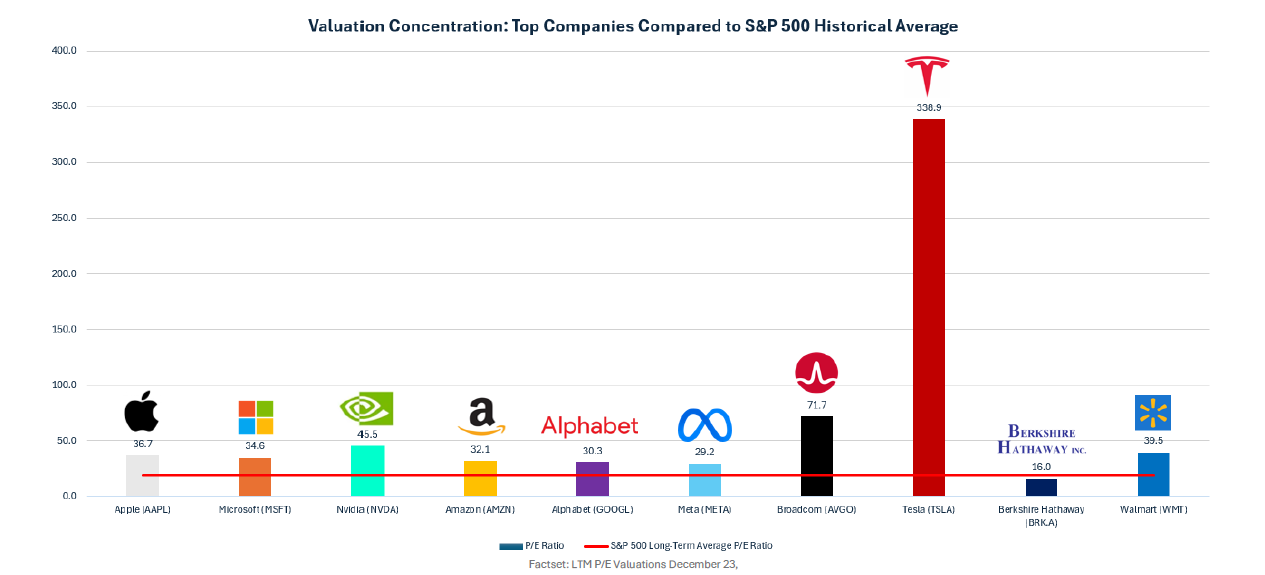
The long-term average Price to Earnings ratio for the S&P 500 is around 19.5x. That gap is worth paying attention to.
This isn’t just a valuation story. It’s a structural one. When trillions flow into passive strategies, the largest companies receive the largest allocations regardless of fundamentals. That feedback loop can distort diversification and amplify downside risk.
Indexing can still work, but investors should understand what they own and why. It’s also important to recognize that the performance of the index does not match the performance of the average investor in that index.
Many underperform because they panic during market downturns as they feel the full brunt of it and sell at inopportune times.
A major market interruption can be difficult for individual investors to withstand, especially when they have goals tied to shorter time horizons. As mentioned in a previous LinkedIn post, we define risk as the permanent loss of capital. Unfortunately, when markets are in flux, many people will realize permanent losses.
Reminders Ahead of Tax Season
RRSP Contributions
- Contribute to your RRSP before the March 2 deadline. The earlier you contribute, the better, as you can apply the deduction to the current tax year and reduce your taxable income.
- For more information on the benefits of an RRSP, how to contribute, and for other important information on RRSPs, you can reference our 2026 RRSP Guide.
Disability Benefits
- The Disability Tax Credit (DTC) is a non-refundable federal credit that lowers income tax owed. It helps offset extra living costs for individuals with severe and prolonged physical or mental impairments. You can claim it for yourself or a dependant, and retroactive claims of up to 10 years are allowed.
- Eligibility & Application: A qualified medical practitioner must certify your impairment on Form T2201 (Disability Tax Credit Certificate). Once approved by the CRA, claim the credit on your tax return (line 31600 for yourself, 31800 for a dependant). For 2024, the federal amount is $9,872, plus a provincial portion.
Speak with your accountant to confirm how to best take advantage of these benefits ahead of tax season.
In the News
TFSA investors ring in new year with additional contribution space – BNN Bloomberg
The TFSA limit for 2026 is $7,000, giving savers more room to grow tax-free. Why it matters? More room in a tax-preferred account for your investments to grow tax-free.
Waren Buffet’s Legacy as Berkshire’s Pitchman – CNN Business
With Warren Buffett retiring and Berkshire Hathaway transitioning to new leadership, Buffett’s personal brand (rooted in honesty and clarity) has become inseparable from the company’s reputation. He didn’t just buy and sell stocks; he championed long-term investing, prudent risk management, and ethical business practices. Buffett’s gift for connecting with everyday investors, explaining market events in plain language, and openly admitting mistakes set a gold standard for leadership and communication.
Cash Gab Book of the Month
Book: The Psychology of Money
Author: Morgan Housel
Summary: This book is a collection of short stories that explore the unique ways that people think about money. It argues that financial success isn’t about knowledge but behaviour. A few key takeaways:
- Money decisions are emotional, not logical.
- Long-term thinking beats short-term wins.
- Save for flexibility, not just for goals as money buys freedom, not just stuff.
- Compounding is powerful but requires patience.
- Tailor your financial plan to YOU, not just a spreadsheet.
This book is one that I highly recommend.
The Ross Group: Who We Are

At Ross Group Wealth Advisors, we work with future-minded investors to keep them on track toward greater wealth. Through our unique approach to portfolio management and wealth planning, we deliver smart risk and tax strategies and guide sound decisions that secure their wealth and expand their lives.
What We Provide
We act as your financial quarterback, building comprehensive, long-term strategies, not quick fixes. Our wealth plans aim to minimize taxes and safeguard your financial health today and for the future.
We proactively review your portfolio and overall financial picture, update your wealth plan regularly, and ensure you stay aligned with your goals. We engage with your priorities, uncover opportunities, and challenge assumptions about what you can do and when.
Community Engagement
Subscribe!
Subscribe to the Cash Gab with Noah Newsletter to receive every issue by email as soon as it's released
In-person Cash Gab Session
What is a Cash Gab Session?
Cash Gab brings together peers in similar careers and life stages to share, listen, and learn about financial topics that matter to you. The goal is to build a community of like-minded, future-oriented people aiming to achieve financial freedom.