Income and the Price of Growth | October 2026 Investment Letter
Christopher Bowlby - Oct 14, 2026
Higher bond yields offer an income opportunity as hiring softens and stocks enter Q3 earnings near record highs. Our October outlook examines what this means for your portfolio.
TLDR
- Bonds: Inflation pressure, heavy government borrowing and AI investment have pushed yields higher. The U.S. 10-year reached 5.31% on October 5, its highest daily yield since 2002. Higher income comes with duration risk: longer-dated bonds have greater price sensitivity to changes in yields.
- The economy: Canadian GDP stalled in July, and hiring has weakened in both countries. U.S. GDP is still growing, but household income is not keeping pace with spending. The Fed raised rates in September as energy and tariff pressures complicated its inflation fight. Canada's investment push and proposed closer EU ties offer a longer-term growth opportunity; delivery remains the test.
- Equities: U.S. stocks remain near record highs entering Q3 earnings season, supported by strong profit expectations. Companies now need to deliver the earnings and guidance that justify those prices.
- Our approach: Lock in attractive yields on high-quality bonds, including selective purchases below par, with maturities mainly three to seven years and below ten. In equities, remain focused on growth at a reasonable price (GARP), using Q3 results to reassess each investment thesis.
- The risks: The Iran war threatens to keep fuel costs elevated into winter, increasing the risk of higher costs reaching consumers. California diesel averaged US$8.08 per gallon on October 5. Cook Political Report favours Democrats regaining the House, which could constrain Trump's legislative agenda; inflation and policy uncertainty remain unresolved.
Our view
Higher yields offer an opportunity to secure more income from high-quality bonds. The forces behind them also create challenges for businesses and households: renewed inflation pressure, heavy government borrowing and large demands for investment capital. Hiring has weakened in Canada and the United States, yet U.S. stocks remain near record highs as Q3 earnings begin.
The difficult combination is slower hiring alongside persistent inflation. Softer demand can weaken company earnings, while elevated energy and trade costs limit the room for central banks to reduce rates. The Iran war and approaching U.S. midterms add uncertainty to the outlook for costs and policy.
For a family with investments, a business and borrowing, that assessment belongs alongside planned withdrawals, debt renewals and Canadian- and U.S.-dollar expenses. These obligations determine how much capital needs to remain accessible and which currency it must ultimately deliver.

Bonds: more income, with a maturity decision
Canada's 10-year government bond yield rose by 40 basis points between April 13 and October 9. The U.S. equivalent rose by 94 basis points. The U.S. 10-year reached 5.31% on October 5, its highest daily observation since 2002, before easing to 5.24% on October 9. Canada's 3.86% October 9 yield is higher than in April, but remains below its 2023 peak.
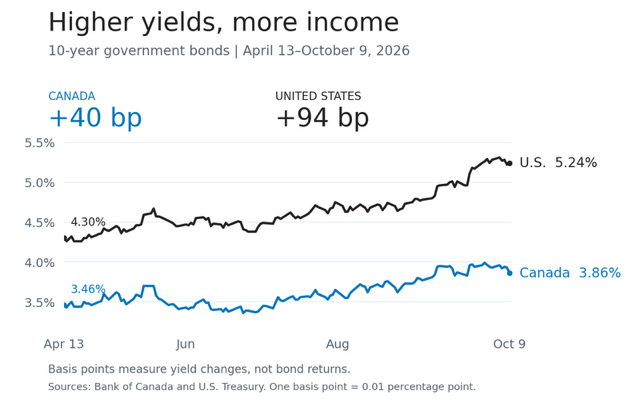
For investors buying bonds, higher yields improve the income opportunity. For holders of existing bonds, rising yields reduce market prices. For borrowers, the same move raises the cost of financing. A family can experience all three effects at once through its portfolio, business and real estate.
The Bank of Canada's September hold at 2.25% does not contradict higher long-term yields. Its policy rate governs overnight money. Investors lending for ten or thirty years also consider future inflation, expected policy rates and compensation for committing capital over time. U.S. developments influence that judgment in Canada: Bank of Canada research finds that U.S. economic announcements often move Canadian long-term yields more than comparable domestic news.
Energy and tariff pressures complicate expectations for inflation and future policy rates. Governor Michael Barr's September assessment also identifies AI-related demand as a source of price pressure. Investors lending for longer periods must consider how much those prices could erode the purchasing power of future payments.
The supply of debt matters too. BMO Economics' October 9 fiscal review, drawing on Congressional Budget Office estimates, puts the U.S. fiscal 2026 deficit at about US$2 trillion. Government financing needs and the capital required for AI infrastructure add to borrowing demand. BMO argues that this combination can keep pressure on bonds; BIS research also identifies an increase in the premium investors require for holding longer-term debt. Lower inflation would help, but it would not remove every source of pressure on yields.
Our preference is to secure attractive yields on high-quality bonds, with maturities mainly three to seven years and below ten. This limits exposure to the larger price swings associated with long-duration bonds, while retaining the opportunity to earn income for several years. Maturity is only one part of that assessment: coupon rates and other bond features also affect duration, the measure of sensitivity to changes in yields.
Selective purchases below par can add an opportunity to earn the difference between the purchase price and face value if the issuer repays in full at maturity. The discount alone does not make a bond attractive. We assess the yield to maturity, credit quality, any early-redemption terms and expected cash income. Locking in a coupon schedule is not a guaranteed floor under the bond's market value or total return.
Consider a family planning a withdrawal in three years while also investing for the next generation. The withdrawal has a deadline. A bond-price decline near that date could limit flexibility. The longer-term capital can tolerate a different investment horizon. The maturity decision should reflect those different obligations.
U.S. bonds introduce another calculation. A higher quoted yield can be offset by currency movements, hedging costs and taxes. The relevant comparison is the income and risk in the currency the family expects to spend. Cash remains useful for near-term commitments, although its income resets as it is reinvested.
Canada: the growth case depends on delivery
Canada's near-term economy has softened. After second-quarter GDP growth of 0.8% from the previous quarter, output was essentially unchanged in July. Employment fell by 68,000 in September following August's 42,000 decline, and unemployment reached 6.5%. The composition matters: September's public-sector employment fell by 70,000, while private-sector employment was little changed. The report gives reason for caution without establishing a sudden contraction across private businesses.
Households have less room for setbacks when employment weakens and living costs remain elevated. August inflation was 3.0%; excluding gasoline, it was 2.4%. The next question is whether hiring and purchasing power can support continued spending. Preliminary August GDP growth of 0.2% offers some encouragement, but the official release is still ahead.
Capital at home, markets abroad. Two September developments deserve attention beyond the weak monthly data. The federal government reported nearly $500 billion in commitments from the Canada Investment Summit, including almost $325 billion in bank financing and nearly $100 billion in planned institutional investment. Some financing extends over five or ten years. This is a substantial pool of potential funding for infrastructure, energy, critical minerals and technology, but it combines different activities and time horizons. It is not $500 billion of completed spending or an immediate addition to GDP.
Carney's September 17 address to the European Parliament sets out the other part of the growth agenda: deeper ties with Europe. He welcomed the prospect of Canada becoming the EU's first associate member and proposed closer cooperation in energy, critical minerals, defence, technology and financial services. The proposed partnership's terms remain to be defined; the speech does not establish membership or new market access. For Canadian businesses, the opportunity is a wider customer base and stronger investment partnerships, reducing dependence on a single export market.
Together, these initiatives address two needs: capital to build productive capacity and markets in which to sell its output. We see them as a reason to examine Canadian opportunities more closely. Our investment case still depends on funded projects, commercial contracts and returns that justify the capital committed.
LNG Canada's Phase 2 investment decision and the proposed West Coast Oil Pipeline's national-interest designation are milestones. The pipeline remains in early development, with its route and further regulatory work ahead. Financing, construction and eventual output will determine the economic benefit.

BMO Economics forecasts Canadian growth of 1.0% in 2026 and 1.8% in 2027, with Ontario and Quebec growing by less than 1% this year and energy-producing provinces faring better. That uneven outlook argues for examining where a business earns its revenue and how it funds expansion. A Canadian listing alone says little about its dependence on domestic households.
The United States: spending needs income support
U.S. consumer spending remains a source of growth. In August, inflation-adjusted spending rose 0.6% while real after-tax income was unchanged. Second-quarter GDP was revised up to 2.2% annualized. Spending can outpace income for a period; a durable expansion needs income to contribute.
The jobs data make that support less certain. September payrolls rose by 29,000 and unemployment reached 4.2%. August hiring was revised down to 133,000, while July was revised to a loss of 10,000. Services activity continued to expand in September, so the evidence points to slower momentum rather than an established economy-wide contraction.
Inflation complicates the policy response. The PCE measures shown below remain above the Fed's goal. The Fed raised its policy rate to 3.75%-4.00% in September; minutes released October 7 showed most participants considered another increase appropriate by year-end, depending on incoming information. That discussion preceded the weaker September jobs report.
U.S. inflation | August 2026
3.4% Headline PCE inflation | 3.0% Core PCE inflation |
The Fed's formal goal: 2% headline PCE inflation.
Governor Michael Barr's September 29 assessment identifies tariffs, higher Middle East energy costs and AI-related demand as sources of renewed inflation pressure. This explains why softer hiring does not automatically create room for rate cuts.
Why the Fed's task is unusually difficult. In Goldman Sachs' September 23 Exchanges episode, vice chairman and former Dallas Fed president Rob Kaplan describes an economy moving at different speeds. AI infrastructure and defence spending are strong, while housing, autos and businesses serving lower-income consumers are already strained. Further rate increases would bear on those weaker sectors without necessarily slowing the largest investment programmes. This helps explain how soft hiring can coexist with inflation pressure.
Kaplan argues that markets may be pricing in too many hikes. He favours an October pause, a possible December increase and then reassessment, with persistent oil-driven inflation a reason more tightening could be needed. These are Kaplan's views, expressed before the latest jobs report, rather than an institutional Goldman Sachs forecast. BMO Economics also favours an October pause while expecting further tightening ahead. For investors, a pause would allow more assessment; it would not guarantee lower long-term bond yields.
Energy costs and winter inflation. We see the Iran war as a winter inflation risk for Europe and North America. EIA's October 6 outlook assumes constrained Middle East oil flows through the fourth quarter and below-normal East Coast distillate inventories through winter. Its October 5 survey puts diesel at US$8.08 per gallon in California and US$6.20 nationally. These are dated regional and national averages.
Higher fuel costs put pressure on freight, production and household budgets. Businesses must decide how much to absorb in margins and how much to pass to customers as contracts and prices reset. The extent and timing depend on demand, competition and existing agreements. The 2022 experience is a reason to watch for energy costs spreading into broader inflation, alongside their immediate effect at the pump.
The midterms and the policy outlook. Cook Political Report's October 9 House projection implies a Democratic majority. That outcome could constrain Trump's legislative agenda and change the prospects for spending, tax and regulatory proposals. It remains a forecast. For investors, a change in Congress would alter the legislative outlook; energy prices would continue to depend on supply and the course of the conflict.
For companies, the test is whether productivity and pricing can absorb higher wages, financing and trade costs without undermining demand. AI investment may improve productivity, but expenditure alone does not demonstrate an economic return. We prefer businesses that generate cash and can fund their plans without depending on continually favourable financing.
Equities: earnings must justify the price
U.S. stocks remained near records on October 12 as Q3 earnings season began. Strong profit expectations support that confidence, but they also set a demanding test for companies. The charts below show both major indices relative to their 50-day and 200-day moving averages. Only 19 companies had reported at the October 9 assessment.
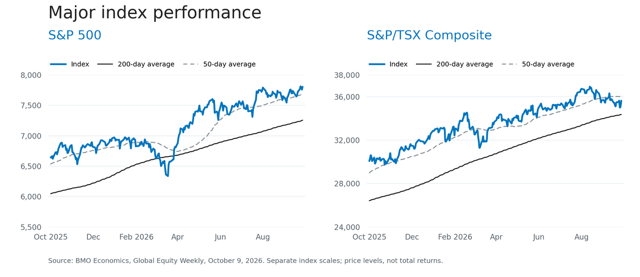
Major index performance with 50-day and 200-day moving averages. Separate index scales; price levels, not total returns. Redrawn from BMO Economics, Global Equity Weekly, October 9, 2026.
That distinction matters when expectations are already high. Beating an estimate is one test. Sustaining sales, margins and cash flow is a more demanding one, especially if the forecast has been reduced beforehand. Guidance also matters: this quarter's results tell us what happened; management's orders, costs and investment plans help explain what may follow.
BMO Economics' October 9 equity review highlights stronger large-technology performance relative to smaller companies. We want evidence that profit growth extends beyond the largest businesses. Broader growth would make the market's advance less dependent on a small set of results.
Higher bond yields also change the comparison investors make. Equities must compensate for business risk while bonds offer more income. A profitable company can still be an expensive investment, and a high expected growth rate leaves less protection if execution falls short. Our focus is the price paid relative to realistic cash generation and financing needs.
Canada's energy exposure illustrates why index performance needs interpretation. Higher oil prices can improve producer earnings while increasing transport costs and squeezing household budgets. Reports of attacks on shipping near the Strait of Hormuz reinforce the supply risk. An energy-led TSX gain would not establish a stronger outlook for every Canadian business.
There is a credible case for a better outcome. If inflation eases, employment stabilizes and earnings broaden, companies could grow while financing pressure recedes. We would become more confident as those developments appeared together. Persistent inflation, falling earnings estimates and weaker household income would warrant more caution.
Our equity approach remains growth at a reasonable price, or GARP: seek businesses with durable earnings growth without paying a price that assumes flawless execution. Q3 is an opportunity to reassess each investment thesis. We will examine whether sales and cash flow support the expected growth, whether energy or tariff costs are changing margins, and whether guidance supports the earnings assumptions behind the valuation. A business can report a good quarter and still offer an unattractive price; it can also miss a quarterly estimate while its longer-term case remains intact. Our assessment needs to account for both the business and the price.
What we are watching
The next few weeks will test the relationship between income, profits and financing costs. We will assess the pattern across releases and company results, rather than let one monthly number determine the outlook.
Earnings and investment theses
Sales, margins, cash flow and guidance will test our assumptions about individual businesses. Results across smaller companies and sectors outside technology will also show whether growth is spreading. Broader profits would strengthen our confidence; falling estimates or greater dependence on fewer companies would weaken it.
Inflation and long-term yields
Cooling underlying inflation alongside steady activity would improve the case for less financing pressure. Persistent price increases or a sustained rise in long yields would challenge borrowers and valuations. We will distinguish policy-rate decisions from the rates families and companies face over longer periods.
Employment and household income
Hiring, hours worked and inflation-adjusted income will show whether consumers can sustain spending. Stable employment and stronger purchasing power would support the growth case. Repeated job losses alongside weak income would make it less durable.
Energy and trade costs
Freight charges, supplier prices and company margins will show how much of the fuel shock is reaching the wider economy. Rising costs alongside weaker demand would deepen the concern. Steadier supply and companies absorbing costs without damaging profitability would ease it.
The midterms and policy
We will track the outlook for House and Senate control and the implications for legislation. A shift in Congress could change the policy agenda; it would not by itself resolve energy-market disruption. The election outlook remains a scenario in our assessment, not an assumed result.
Currency exposure
A stronger Canadian dollar reduces the Canadian-dollar return on an unhedged U.S. holding, all else equal; a weaker dollar lifts it. We will assess that exposure against the family's Canadian- and U.S.-dollar obligations. Changed spending needs are a more useful reason for review than a short-term exchange-rate forecast.
Canadian investment and trade diversification
We will look for Summit commitments becoming financing agreements, equipment orders and construction. On Europe, the tests are defined partnership terms, practical market access and commercial contracts. Additional capacity with customers to support it would strengthen the growth case. Delays, cost overruns or announcements without investment follow-through would weaken it.
The calendar below identifies the next scheduled checkpoints. Their results are outside this edition's October 13 cutoff.
The next checkpoints
| October 14 | U.S. September CPI |
|---|---|
| October 19 | Canadian September CPI; Bank of Canada business and consumer surveys |
| October 28 | Bank of Canada decision and Monetary Policy Report; Federal Reserve decision |
| October 30 | Canadian August GDP and advance September estimate |
For your family, the next step is to review upcoming withdrawals, business commitments, debt renewals and spending in another currency. Those obligations guide how much income to secure and how much flexibility to preserve, while longer-term capital pursues growth.