MWW - Hello Pumpkin Spice World
DHL Wealth Advisory - Sep 11, 2026
- Investment Services
- Portfolio Management
- Special Reports and Newsletters
- Total Client Experience
- Wealth Management
As we say goodbye to summer and welcome the looming fall season, all eyes are squarely back to Central Banks. With the US Federal Reserve's September 16 policy decision due next week, investors are facing a surprisingly familiar question...
As we say goodbye to summer and welcome the looming fall season, all eyes are squarely back to Central Banks. With the US Federal Reserve's September 16 policy decision due next week, investors are facing a surprisingly familiar question: Are interest rates heading higher again?
Markets are increasingly entertaining that possibility. If the Fed chooses to raise rates, it would mark the first increase in more than two years and signal that policymakers remain uncomfortable with the pace of inflation progress. As of this writing, the Fed funds futures market was pricing in an 88% probability of an increase next week and nearly fully pricing in another by the end of the year. We think that’s about right given some of data in recent weeks.
Meanwhile, the Bank of Canada held rates steady earlier this month but left little doubt that additional tightening remains on the table should inflation fail to cooperate. The next BoC meeting will be on Wednesday, October 28.
The challenge for both central banks is clear. Economic growth remains resilient, employment conditions are relatively healthy, and inflation continues to run above target. The decision ahead is not about responding to a weak economy. Instead, it is about determining whether inflation has cooled enough to justify patience or whether one final push may be necessary.
Employment Remains a Source of Strength
Labour markets continue to be one of the most important indicators for policymakers.
In the United States, August employment data surprised to the upside. Hiring accelerated meaningfully from the prior month, while unemployment held near historically low levels. The steady unemployment rate is particularly notable given that more individuals entered the workforce, suggesting labour demand continues to absorb new workers without significant strain.
Canada's employment picture was less encouraging, with job losses recorded during the month. However, the unemployment rate remained unchanged, indicating that while momentum has softened, conditions have not deteriorated dramatically. For central bankers, the key takeaway is that neither economy appears to be experiencing a labour market downturn that would require interest rate relief. The employment backdrop still provides room to maintain a restrictive policy stance if necessary.
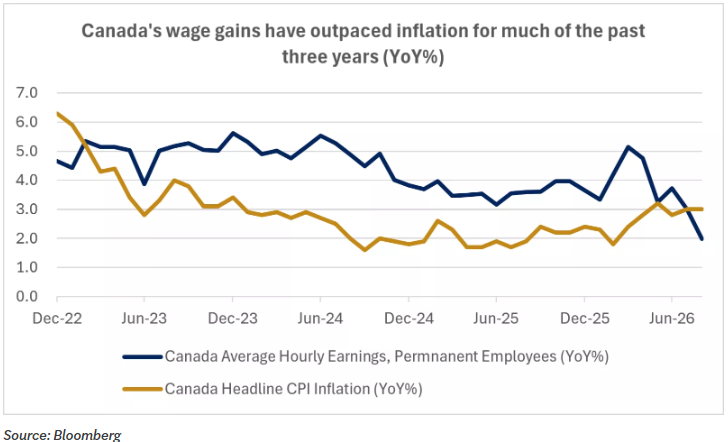
Wage Pressures Are Moving in the Right Direction
Employment alone does not determine inflation risks. Wage growth is equally important.
If employers are forced to continually bid up compensation to attract workers, those higher labour costs can eventually feed into consumer prices. Fortunately, recent data suggests that wage growth is gradually cooling across North America. In both Canada and the United States, wage gains have eased from peak levels reached over the past several years. While workers continue to see income growth, the pace is becoming more consistent with an environment of moderating inflation. This is an encouraging development. Policymakers would much rather see wage growth settle at sustainable levels than weaken because of a sharp increase in unemployment. So far, the data points toward normalization rather than deterioration.
Inflation Will Ultimately Decide the Outcome
While labour market data provides context, inflation remains the deciding factor.
The progress achieved since the inflation peak has been significant, but the final stretch toward central bank targets has proven more difficult. Services inflation, housing costs, and certain consumer categories continue to show persistence. In addition, energy prices and trade-related uncertainties remain potential sources of volatility.
The next inflation releases in both countries may therefore carry more weight than any other recent economic report. Policymakers will be looking for confirmation that inflation is resuming its downward path rather than becoming stuck above target levels.
A particularly important positive is that long-term inflation expectations remain relatively well anchored. Financial markets continue to signal confidence that inflation will eventually move back toward central bank targets. Maintaining that confidence is critical, and central banks may be willing to act aggressively if they believe credibility is at risk.
What Does This Mean for Investors?
While another rate hike would likely generate headlines and short-term market volatility, we do not believe it would fundamentally change the broader investment landscape.
Economic activity on both sides of the border continues to expand at a reasonable pace, corporate earnings remain healthy, and businesses have generally adapted to today's higher-rate environment. A modest policy adjustment, if implemented, would be aimed at controlling inflation rather than slowing an already weak economy.
For long-term investors, the message remains largely unchanged. Inflation is best addressed through ownership of quality assets capable of growing earnings and cash flows over time. Maintaining diversification across sectors, regions, and market capitalizations remains one of the most effective ways to preserve purchasing power and participate in long-term wealth creation.
We continue to see attractive opportunities in U.S. large-cap companies, Canadian small- and mid-cap equities, and select emerging markets. While central bank decisions will continue to drive near-term market attention, we believe the bigger story remains one of economic resilience, improving earnings growth, and a gradual return toward price stability.
The coming weeks may determine whether policymakers choose to tighten one final time. Either way, investors should remember that successful long-term investing is rarely determined by a single rate decision, but rather by staying invested through the full economic cycle.
NOTE: Due to upcoming vacation time, this will be the last Market Watch Weekly publication until October 6, 2026.
Sources: BMO Capital Markets Economic Research- BMO Economics Talking Points: “Hasn’t Hit Me Yet”; BMO Economics Talking Points: Not in Kansas or a Low-rate World Anymore