MWW-No Country for Low Yields
DHL Wealth Advisory - Aug 28, 2026
- Investment Services
- Portfolio Management
- Special Reports and Newsletters
- Total Client Experience
- Wealth Management
After a strong earnings season helped lift North American equity markets to record highs in early August, stocks finished the last week of August on an positive note despite the bond market moving to centre stage.
After a strong earnings season helped lift North American equity markets to record highs in early August, stocks finished the last week of August on an positive note despite the bond market moving to centre stage. Rising long-term U.S. yields raised concerns about whether the economy and financial markets could continue to withstand higher borrowing costs, particularly as the 30-year U.S. Treasury yield reached its highest level since 2007 early in the week. With Canadian and U.S. financial markets closely intertwined, longer-term Canadian government bond yields also traded higher last week.
What has made this move particularly noteworthy is the backdrop against which it has occurred. Recent economic releases have generally pointed to softer labour market conditions, moderating inflation pressures, and diminished expectations for additional Federal Reserve rate hikes. Under normal circumstances, those developments would be expected to support lower bond yields rather than higher ones.
The unexpected rise in longer-term yields has also attracted the attention of policymakers. In response, the U.S. Treasury Department announced plans to increase its long-term Treasury buyback program beginning next month, highlighting the growing focus on financial conditions and bond market liquidity.
While there is no single explanation for the upward movement in yields, several factors appear to be contributing. One is the increased supply of bonds entering the market. U.S. investment-grade corporate bond issuance remains elevated, with year-to-date issuance through July running more than 27% ahead of the same period last year. Greater supply often requires higher yields to attract investors.
Geopolitical developments may also be playing a role. Oil prices have rebounded significantly since early July as uncertainty surrounding Middle East tensions and energy supply routes has persisted. West Texas Intermediate crude rose from below US$70 per barrel to above US$85 last week, prompting renewed discussion around the future path of inflation. Encouragingly, longer-term inflation expectations remain relatively stable, and recent Canadian inflation data suggest underlying price pressures remain close to the Bank of Canada's target range.
The increase in yields has not been limited to North America. Government bond yields across major economies, including the United Kingdom, Germany, France, and Japan, have also moved toward multi-year highs. Although local factors vary by country, the common themes of elevated government borrowing requirements, lingering inflation uncertainty, and expectations for higher policy rates globally have contributed to the trend.
Another consideration is investor sentiment toward long-term bonds themselves. Investors may simply be demanding greater compensation to hold longer-dated securities in an environment characterized by economic, fiscal, and geopolitical uncertainty. Consistent with this view, the New York Fed's measure of the U.S. Treasury term premium has generally trended higher in recent years. While the measure remains well below past extremes, it suggests investors are requiring a greater premium for taking on duration risk than they did during the low-rate era.
Higher borrowing costs continue to weigh on interest-rate-sensitive sectors, particularly housing. Residential investment has weakened in both Canada and the United States, and housing market activity has slowed from the levels seen when financing costs were significantly lower. These developments demonstrate that tighter monetary policy is continuing to work its way through the economy.
The silver lining, in our view, is that several areas of the economy have remained resilient despite higher interest rates. In Canada, employment growth has improved in recent months, while June retail sales pointed to healthy consumer spending at the end of the second quarter. In the U.S., the preliminary reading for the S&P Global Composite PMI rose to 56.04, its highest reading since March 2022 and signaling healthy business activity.
Corporate earnings have provided another source of support for markets, with results exceeding expectations this year. TSX earnings are on pace to grow 25% year-over-year in 2026, while S&P 500 earnings are tracking growth of more than 30%.
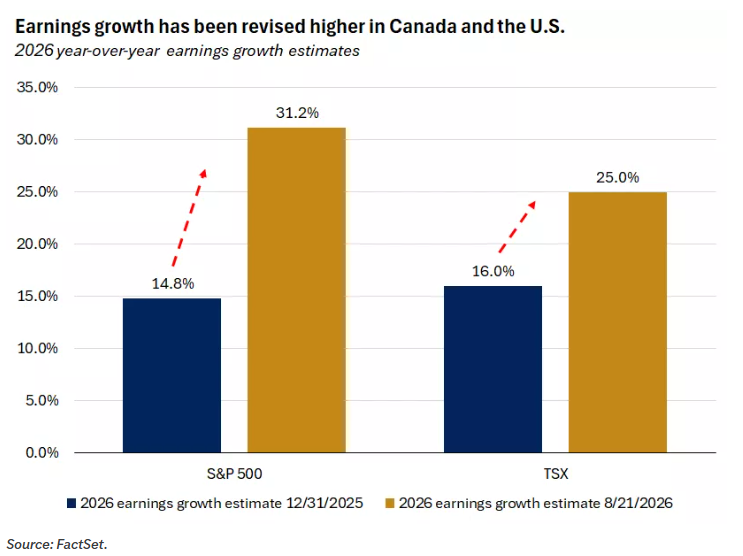
Looking ahead, we continue to believe that equities offer the more attractive opportunity over the next 12 months. Profit growth remains healthy, economic activity continues to expand, and corporate fundamentals are generally supportive. While markets may experience a period of consolidation following the strong gains recorded this year, we would view any resulting weakness as a potential opportunity for long-term investors. Political uncertainty surrounding the upcoming U.S. midterm elections may contribute to bouts of volatility, but the overall backdrop remains constructive for equities.
And we would be remise if we didn’t touch on the elephant in the room. Trade. Or lack there of. This week we learned that the Government of Canada will implement counter-tariffs on C$27.6 billion of imports from the U.S., matching “dollar for dollar” the U.S. ‘Section 338’ 50% tariffs on Canadian goods (which came into effect August 22). The new Canadian duties are effective September 8.
The tariff rates are mostly either 25% or 50%, although some items get 15%. The focus is on steel, dairy, appliances, agricultural equipment, pulp and paper, and electronics, i.e., the Canadian sectors most impacted by U.S. tariffs (both the 232s and the 338s). Based on the latest available data, the new tariff rates touch around 7% of U.S. exports to Canada.
At the same time, and in addition to existing tariff support (which Ottawa says amounts to nearly C$25 billion), a $7.5 billion package of new and enhanced support measures was also announced. The package includes:
• $1.5 billion towards the existing Regional Tariff Response Initiative for SMEs, including liquidity support
• $500 million in liquidity under the Pivot to Grow program to address immediate cash flow pressures
• $2 billion to support ongoing capital maintenance via the Canada Strong Diversification Fund
• $3.5 billion for workers, including: income supports; extended and additional EI benefits; retraining; and, worker retention programs
• Expanding eligibility for the BDC's tariff programs and loosening restrictions to the Large Enterprise Tariff Loan facility
Implications for Canada: In isolation, economists estimate the Section 338 tariffs could cut 0.5 ppts from Canadian GDP growth (if the duties remain in place for a year). The new support measures will mitigate some of the hit to growth. And, the new counter-tariffs should have an inflationary impact, although the magnitude is unclear because many of the U.S. goods facing hefty tariffs have Canadian and/or non-U.S. alternatives. A Bank of Canada study from May 2025 found about a quarter of last year's counter-tariffs was passed through to retail prices. Based on that estimate, this round of measures could bump CPI inflation by roughly 0.1-to-0.3 ppts. Any erosion of purchasing power will be a further drag on GDP growth.
The overall net negative economic impact should get the Bank of Canada leaning (verbally) to the easing side. The Bank has previously stated that a worsening of the trade war was a key risk that could cause rate cuts. Offsetting some of the dovish lean, the Canadian economy was gaining momentum recently as this new headwind hits. Moreover, the Bank will also be leery of any new inflation risks posed by the counter-tariffs. Weighing on the other side, core inflation trends have been quite well-behaved.
Sources: BMO Economics EconoFACTS: Next Salvo in the Trade War
The opinions, estimates and projections contained herein are those of the author as of the date hereof and are subject to change without notice and may not reflect those of BMO Nesbitt Burns Inc. ("BMO NBI"). Every effort has been made to ensure that the contents have been compiled or derived from sources believed to be reliable and contain information and opinions that are accurate and complete. Information may be available to BMO Nesbitt Burns or its affiliates that is not reflected herein. However, neither the author nor BMO NBI makes any representation or warranty, express or implied, in respect thereof, takes any responsibility for any errors or omissions which may be contained herein or accepts any liability whatsoever for any loss arising from any use of or reliance on this report or its contents. This report is not to be construed as an offer to sell or a solicitation for or an offer to buy any securities. BMO NBI, its affiliates and/or their respective officers, directors or employees may from time to time acquire, hold or sell securities mentioned herein as principal or agent. NBI will buy from or sell to customers securities of issuers mentioned herein on a principal basis. BMO NBI, its affiliates, officers, directors or employees may have a long or short position in the securities discussed herein, related securities or in options, futures or other derivative instruments based thereon. BMO NBI or its affiliates may act as financial advisor and/or underwriter for the issuers mentioned herein and may receive remuneration for same. A significant lending relationship may exist between Bank of Montreal, or its affiliates, and certain of the issuers mentioned herein. BMO NBI is a wholly owned subsidiary of Bank of Montreal. Member-Canadian Investor Protection Fund. Any U.S. person wishing to effect transactions in any security discussed herein should do so through BMO Nesbitt Burns Corp.