MWW - Fear, FOMO and Fundamentals
DHL Wealth Advisory - Nov 27, 2026
- Investment Services
- Portfolio Management
- Special Reports and Newsletters
- Total Client Experience
- Wealth Management
North American markets had their best week in almost 2 years as capital markets have been on a wild ride, leaving many investors’ psyches (and stomachs) churning. Are fundamentals truly changing as markedly as the gyrations imply (spoiler alert: no)?
North American markets had their best week in almost 2 years as capital markets have been on a wild ride, leaving many investors’ psyches (and stomachs) churning. Are fundamentals truly changing as markedly as the gyrations imply (spoiler alert: no)? This week we parse the situation through the lens of behavioral finance, highlighting nuggets to help anchor a more measured perspective.
Scientists have discovered that crows respond to visual cues at twice the speed of humans and other primates. Thankfully we don’t let them trade stocks – the velocity of twists and turns in markets over the last two weeks has already been enough to give investors whiplash. But who said speed is the be-all and end-all anyway? In financial decisions, haste can actually prove detrimental to long-term outcomes.
The rapidly shifting headlines we’ve been inundated with have triggered an almost irresistible urge to act – even if we know we should ignore the noise. Why? Blame it on the oldest, most primitive parts of our brain. We like to think we are deliberative and careful decision-makers, yet we are habitually more influenced by innate hardwiring than we care to admit.
Behavioral economics presumes we frequently make flawed or biased choices influenced by observable mental shortcuts (termed heuristics). These tendencies are typically rooted in primitive wiring that overrides logic, particularly when we’re stressed. Studies identified two primary decision-making systems:
Fast: primitive wiring causing us to fight, flee or freeze in response to unexpected stimuli. This is also the rote/routine way we handle the thousands of decisions we make each day as we operate from habit and embedded (comfortable) routines.
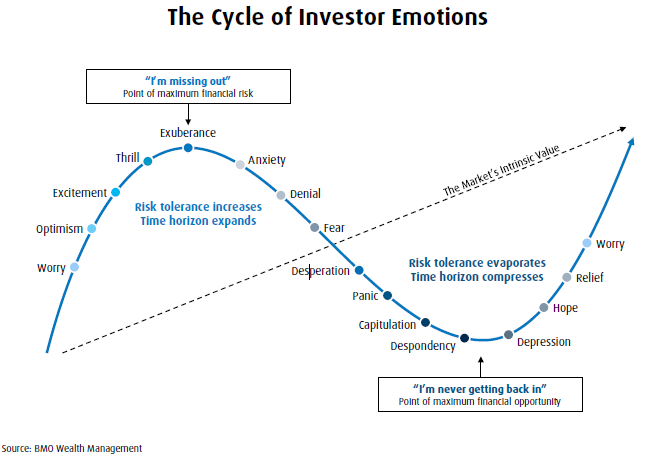
Slow: a more deliberative and analytic state that often requires specific, effortful intention to operate from. Investor behavior continuously swings between greed and fear. Back and forth, forth and back, over time markets are pushed to extremes before they exhaust excess and migrate back toward equilibrium. We can see from the chart below how emotions play a substantial role in the market cycle.
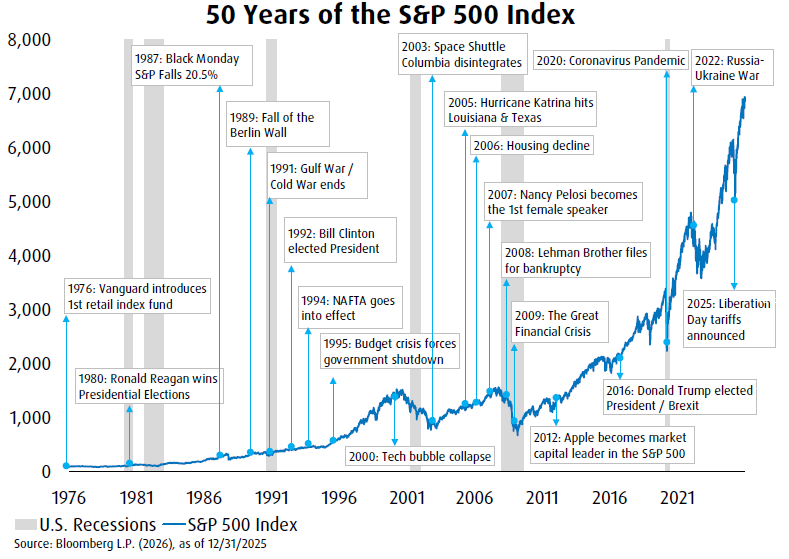
What routinely gets overlooked is that those pendulum swings happen around a trend line that tends to climb up and to the right over the long haul, regardless of the barrage of concerning news stories blasted at us along the way. This chart shows some pretty high profile headlines that hit along an even longer stretch of market advance.
Emotional swings can be chalked up to some of the biases that behavioral finance exposed:
Herd behavior. Our brains are literally wired to fear ostracization, which in early civilizations could be a death sentence. Despite how advanced we like to think we are, our brain’s hardwiring hasn’t caught up. Today, being the last one picked for the dodgeball team (or excluded from the hottest new investment club) still triggers ancient brain chemicals that come from the very same place that sends out physical pain messages. Market FOMO (fear of missing out) is very real according to our brain chemistry. We are also born story tellers – imparting life-saving information to the pack about which plants are poisonous or where the saber-tooth tiger was last seen (or helping amplify market trends via our social media feeds).
Loss aversion. Numerous studies show we are twice as distressed by losses as we are thrilled by similar-sized gains. A perfect illustration of this emotional reaction is the drumbeat of panic headlines asking whether we’re in a bubble – especially if the markets have been enjoying a good run. Nevertheless, markets spend most of their time trending upward and by design capture the best and brightest of a country’s economic endeavor.
Anchoring. We instinctively anchor to prior prices. Basically, we rely too heavily on some initial reference point when making estimates or defining options and adjust too little when confronted by new information that warrants an upward shift. This decade’s affordability agitation is arguably tied to pre-pandemic price levels – not to the rate of inflation itself. However, we would not want the type of economic damage it would take to force prices back to those levels. Similarly, housing pain partly reflects anchoring to loan interest rates that prevailed during the unusual period when interest rates were at or near zero. This era was actually an anachronism from a historical perspective: current rates are closer to long-term normal levels.
Recency bias. What happened last week is more memorable than what happened last year. Remember the Sturm und Drang over DOGE? Liberation Day? Deep Seek? Such anguish now pales relative to headlines surrounding rogue AI, datacenters, newly elected policymakers and rolling technology outages. We suspect that a year from now we will be stressing over a whole new list of concerns. We also suspect markets will find a way to claw their way through the list of worries – provided that fundamentals continue to spool constructively, which we expect they will do.
Confirmation bias. Pack animals that we are, we place greater emphasis on opinions, articles and insights that confirm our beliefs versus those that challenge them. Social media and the algorithms that fill our personalized feeds amp this tendency to the nth degree.
Self-attribution. This bias refers to the human tendency to take credit for wins while blaming the markets or external factors for investing losses. Friends and acquaintances will eagerly tell you about the latest investment where they made a “killing.” They are much less forthcoming when the numbers go south.
The dramatic market swings and shifting headlines of the last few weeks have masked an entire suite of constructive fundamentals. Here’s a short list of things going right:
- The U.S. and Canada are both finishing up robust reporting seasons. The S&P 500, for example, now shows 14% topline and 32% bottom-line growth with 95% of results tallied. This marks the third consecutive quarter of 25% or better earnings growth; all 11 sectors showed gains.
- In the face of all this good news, investors continue to punish stocks overall, meaning valuations are lower this week than they were last week (ironic that stocks are one of the only goods we can think of where sale prices seem repellant versus compelling).
- U.S. economic numbers – GDP, productivity and manufacturing activity – show few/no signs of deterioration.
- Canada Strong programs are taking root; investment interest is queuing up substantial potential infrastructure spend for the first time in years.
- Oil prices are down double digits from earlier in the year, setting the stage for stabilizing (falling?) inflation in months/quarters to come.
- AI demand continues unabated – illustrated by backlogs, anticipated chip spending and corporate earnings reports. While moderation of the datacenter build will likely happen thanks to the election results, we expect it to be a slowing – not cessation. Additionally, we expect the grid and infrastructure build needed to support rapidly increasing energy needs will continue to roll along.
Market pullbacks are the rule, not the exception – a feature, not a bug. Much of the market pressure has come in the largest names, primarily the narrow list of technology names that propelled much of the market advance over the last few years. That said, the broadening in participation that we have been watching for is showing green shoots of activity amid the recent gyrations. The Equal-Weight S&P 500 is up 1% in the last month versus a decline of 6% for the standard market cap-weight version.
Implications for investors: tips for outwitting our hardwiring. When markets move sharply, keeping our cool can be difficult – the most reptilian areas of our brains are hardwired for action. A few tactics can help short-circuit this innate tendency:
When surprising news hits – pause. We are one of the few species with the ability to put a space between stimulus and response. Use it to slow down, breathe, educate yourself and evaluate. Acknowledge the media will use incendiary words to generate clicks – it’s what their business models are predicated upon. Words like “plunged, vaulted, soared” are meant to appeal to emotions and trigger a response – don’t rise to the bait. Set up systems – such as dollar-cost averaging (in or out) and regular rebalancing to tamp down the urge to react in the moment. Plan your goals during calm market times – and write them down.
Perhaps the most valuable investment decision during turbulent markets is sometimes the decision not to make one. Giving the “slow” part of our brain time to catch up allows fundamentals, rather than fear or FOMO, to guide the process. Volatility will eventually settle, headlines will move on and, if fundamentals continue to progress as we expect, disciplined investors should be well positioned to benefit from what comes next.
Sources: BMO Private Wealth Publication, Weekly Strategy Perspectives – Efficient Markets and Rational Investors: Fact or Fiction?
The opinions, estimates and projections contained herein are those of the author as of the date hereof and are subject to change without notice and may not reflect those of BMO Nesbitt Burns Inc. ("BMO NBI"). Every effort has been made to ensure that the contents have been compiled or derived from sources believed to be reliable and contain information and opinions that are accurate and complete. Information may be available to BMO Nesbitt Burns or its affiliates that is not reflected herein. However, neither the author nor BMO NBI makes any representation or warranty, express or implied, in respect thereof, takes any responsibility for any errors or omissions which may be contained herein or accepts any liability whatsoever for any loss arising from any use of or reliance on this report or its contents. This report is not to be construed as an offer to sell or a solicitation for or an offer to buy any securities. BMO NBI, its affiliates and/or their respective officers, directors or employees may from time to time acquire, hold or sell securities mentioned herein as principal or agent. NBI will buy from or sell to customers securities of issuers mentioned herein on a principal basis. BMO NBI, its affiliates, officers, directors or employees may have a long or short position in the securities discussed herein, related securities or in options, futures or other derivative instruments based thereon. BMO NBI or its affiliates may act as financial advisor and/or underwriter for the issuers mentioned herein and may receive remuneration for same. A significant lending relationship may exist between Bank of Montreal, or its affiliates, and certain of the issuers mentioned herein. BMO NBI is a wholly owned subsidiary of Bank of Montreal. Member-Canadian Investor Protection Fund. Any U.S. person wishing to effect transactions in any security discussed herein should do so through BMO Nesbitt Burns Corp.