MWW - Uncomfortable, But Not Unusual
DHL Wealth Advisory - Nov 20, 2026
- Investment Services
- Portfolio Management
- Special Reports and Newsletters
- Total Client Experience
- Wealth Management
It was another week of significant market volatility, with most major benchmarks now having retrenched well over 10% from their recent highs. The technology-heavy NASDAQ has led the decline, falling approximately 17% from its October peak ...
It was another week of significant market volatility, with most major benchmarks now having retrenched well over 10% from their recent highs. The technology-heavy NASDAQ has led the decline, falling approximately 17% from its October peak (yes, just 5 weeks ago) and, at one point in Friday’s trading actually going into the red for 2026. Canada’s TSX, which had held up considerably better than its U.S. counterparts over the past four to five months, finally gave back some ground, experiencing its worst week since the April 2025 “Liberation Day” selloff. In fact, at the time of writing on Friday, the TSX has declined 1% or more in five consecutive trading sessions. This is something we haven’t witnessed since the Covid Crisis between February 24-28, highlighting just how quickly volatility has broadened across markets.
That’s the unpleasant part of this week’s MWW. We believe the current bout of weakness is nothing more than a routine pause in year four of a new secular bull market. We wrote to this in our October 16th edition on the 4-year anniversary of this current bull market, periods of volatility should not come as a surprise. Markets rarely advance in a straight line, and after several years of strong returns, corrections are both normal and ultimately healthy. They reset sentiment, temper excessive positioning and create opportunities for fundamentals to reassert themselves. The important question is less whether volatility occurs and more whether the economic and earnings backdrop that supports the bull market remains intact.
On that front, we remain constructive. The global economy continues to expand, with Morgan Stanley Research forecasting 3.2% global growth in 2026 and 3.4% in 2027, while arguing that AI-related capital spending, energy-security investment and fiscal spending should provide an important floor under growth. Corporate profits also remain healthy. Very healthy...
Now that most of the earnings results are in (455 of 500 S&P 500 Composite Index companies), for Q3 2026 it looks like we have the third consecutive quarter of earnings growth that tops 25% for the largest publicly held U.S. companies. In our preview of the quarter, we noted that the expectations bar had moved up markedly from earlier periods, making upside surprises that much more difficult. Still, the results are nothing short of jaw dropping, particularly in the fourth year of an economic expansion.
With 90% of reports in, S&P 500 aggregate revenue growth is running at 13% while earnings growth is 27%. This indicates yet again that companies are paying close attention to margins, which allowed top lines to drop in amplified fashion to the bottom line. All 11 sectors participated, led by energy, tech, industrials and materials. Nevertheless, the S&P 500 is down over 5% for the period, bringing the forward price/earnings ratio to around 16 – well below both the five- and 10-year averages.
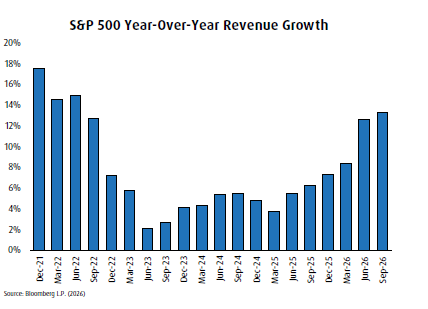
Closer to home, with over 75% of S&P/TSX results in, topline growth is 10% while the aggregate bottom line advanced 40%. Participation here is also broad: 10 of 11 sectors generated revenue growth; nine of 11 sported earnings advances. Leading the way were energy, materials, healthcare and consumer staples. It’s important to remember that the composition of the S&P/TSX (dominated by banks and miners) is quite different than the Canadian economy. Meaning the index can do well even if the economy is adjusting to ever-shifting trade policy and geopolitical headlines. The quarter’s fundamental strength yet valuation moderation tees up a solid foundation for the days ahead. The robustness of the nearly complete Q3 earnings season has been obscured by choppy market action. The surprising outcome of midterm elections added to volatility as investors struggled to factor an altered political landscape into their investment frameworks. The robustness of the earnings cycle – carried through into broader economic progress – supports our conviction that the underpinnings are durable. Better yet, the lower overall stock-price performance relative to double-digit earnings means that valuations ticked down – yet again. We expect the broadening of activity into other sectors, market caps and industries to continue.
Perhaps the most important longer-term support for the earnings backdrop is the enormous capital-expenditure cycle now underway. AI and data centres are the headline, but the investment extends well beyond semiconductors and software into electricity generation, transmission, natural gas infrastructure, construction, cooling and industrial equipment. Morgan Stanley Research expects U.S. business investment to grow about 8% in 2027, while Barclays Research characterizes the AI capex cycle as one likely to be measured in years rather than quarters. In Canada specifically, KPMG Canada expects rising investment to help drive economic growth from 1.0% in 2026 to 1.8% in 2027 and 2.0% in 2028, with technology, energy infrastructure and major projects playing an increasingly important role.
Our takeaway is that the market is increasingly behaving like a maturing bull market rather than one that is fundamentally broken. Volatility is likely to remain elevated as investors digest interest rates, energy prices and questions surrounding the returns on enormous AI investments. But against that stands a growing global economy, healthy corporate profitability and one of the largest investment cycles in decades. Rather than viewing corrections as a reason to abandon equities, we believe periods of weakness can provide opportunities to selectively add to high-quality businesses positioned to benefit from the next phase of economic and capital-spending growth.
Ending with some historical data points from Fidelity to reminder and reassure readers that corrections of this magnitude are the norm, not the exception:
- 5%+ Pullbacks (Minor Dips). The S&P 500 has averaged 3 separate pullbacks of 5% or more per calendar year since 1950. Going back to 1928, 94% of calendar years have experienced at least one 5% dip, and between 1990 and 2026, only 3 calendar years passed without one.
- 10%+ Corrections. Since 1928, a 10% correction has occurred roughly once every 1.8 years (or ~0.56 times per year). Post-WWII data shows 10% corrections occurring roughly once every 2.2 years (~0.45 times per year). Looking at intra-year lows since 1980, Fidelity notes that 48% of calendar years had a drop of 10% or more.
- 20%+ Bear Markets. Declines of 20% or more occur roughly once every 5.0 to 5.6 years (averaging ~0.18 to 0.20 times per year). Since 1928, 26% of calendar years have featured a 20%+ drawdown at some point during the year.
- Intra-Year Volatility vs. Annual Returns. Putting it another way, these are peak-to-trough episodes, not necessarily calendar-year losses. Looking at the deepest decline within each calendar year, the market has experienced at least a 5% setback in roughly 94% of years, a 10% setback in 62%, and a 20% decline in 26% since 1928. Despite these regular intra-year drops, the index has still finished the calendar year with positive returns more than 75% of the time since 1980.
When surprised, markets are often quick to assume outcomes that are much better or much worse than what actually happens – rushing to the extremes of the normal distribution curve or pendulum swings. In reality, the bulk of our existence happens in the middle – where we sit fretting about one extreme or the other. Volatility has a way of making the short term feel far more important than it ultimately proves to be. For patient investors, periods like this are less a reason to retreat and more a reminder that some of the best long-term opportunities are often created when the market feels least comfortable.
Sources: BMO Private Wealth Publication: Weekly Strategy Perspectives – Q3 Earnings Recap: Passing the Baton
The opinions, estimates and projections contained herein are those of the author as of the date hereof and are subject to change without notice and may not reflect those of BMO Nesbitt Burns Inc. ("BMO NBI"). Every effort has been made to ensure that the contents have been compiled or derived from sources believed to be reliable and contain information and opinions that are accurate and complete. Information may be available to BMO Nesbitt Burns or its affiliates that is not reflected herein. However, neither the author nor BMO NBI makes any representation or warranty, express or implied, in respect thereof, takes any responsibility for any errors or omissions which may be contained herein or accepts any liability whatsoever for any loss arising from any use of or reliance on this report or its contents. This report is not to be construed as an offer to sell or a solicitation for or an offer to buy any securities. BMO NBI, its affiliates and/or their respective officers, directors or employees may from time to time acquire, hold or sell securities mentioned herein as principal or agent. NBI will buy from or sell to customers securities of issuers mentioned herein on a principal basis. BMO NBI, its affiliates, officers, directors or employees may have a long or short position in the securities discussed herein, related securities or in options, futures or other derivative instruments based thereon. BMO NBI or its affiliates may act as financial advisor and/or underwriter for the issuers mentioned herein and may receive remuneration for same. A significant lending relationship may exist between Bank of Montreal, or its affiliates, and certain of the issuers mentioned herein. BMO NBI is a wholly owned subsidiary of Bank of Montreal. Member-Canadian Investor Protection Fund. Any U.S. person wishing to effect transactions in any security discussed herein should do so through BMO Nesbitt Burns Corp.