MWW - A Decade In A Week
DHL Wealth Advisory - Nov 13, 2026
- Investment Services
- Portfolio Management
- Special Reports and Newsletters
- Total Client Experience
- Wealth Management
The title is, of course, a shortened take on the quote widely attributed to Vladimir Lenin: “There are decades where nothing happens; and there are weeks where decades happen.” Between the U.S. midterm elections, the Canadian federal budget, jobs ...
The title is, of course, a shortened take on the quote widely attributed to Vladimir Lenin: “There are decades where nothing happens; and there are weeks where decades happen.” Between the U.S. midterm elections, the Canadian federal budget, jobs reports on both sides of the border, further central bank rate moves, a full-blown correction in technology stocks, and now the sudden resignation of one of the world’s most recognizable CEOs, it has been difficult to know where to look the last 10 days.
Last week, we spent considerable time on the technology rout and the U.S. midterm elections, leaving little room to explore developments closer to home. So, we’re turning our attention to last week’s Canadian Federal Budget. We know some of you may not find fiscal policy particularly riveting, but this stuff matters, so bear with us as we dig in.
We’ll focus primarily on the macro implications, although there was also a surprising deluge of smaller measures. For a document that arrived with relatively little fanfare, there was actually quite a bit to digest. In a nutshell, the government was handed another sizeable revenue windfall, this time courtesy of the surge in oil prices, and quickly found plenty of priorities on which to spend much of it.
To give credit where it is due, the deficit for the past fiscal year, ending in March 2026, is now expected to come in at $39.3 billion, or 1.2% of GDP. That is almost exactly half of what was projected in last year’s document and represents a significant improvement. Yet the outlook for this year’s deficit is largely unchanged at $62.3 billion, or 1.8% of GDP, with a similar shortfall expected in the following year.
Looking through the various measures, Ottawa estimates net new spending of $15 billion in the current fiscal year, equivalent to roughly 0.4% of GDP, and another $34 billion next year, or about 1% of GDP. Those figures include a raft of previously announced initiatives, most notably the Productivity Mega Deduction, which is expected to cost $36 billion over five years.
Taken together, this represents a meaningful dose of fiscal stimulus, prompting BMO’s economics team to raise its post-Budget 2027 growth forecast by two ticks to 2.0%, compared with just under 1% this year. The direction of travel seems fairly clear: fiscal policy remains firmly focused on supporting the economy and encouraging stronger growth.
That brings us to an interesting exchange involving Bank of Canada Governor Tiff Macklem during testimony before the House Finance Committee last week. Macklem suggested there was no friction between fiscal and monetary policy. A brief recap of Econ 101: The BoC sets monetary policy through adjustments in their overnight interest rate, while the government is in charge of fiscal policy (aka, big, bloated spending bills). We might respectfully revisit Macklem’s assessment. One could reasonably argue that the two are currently working toward somewhat different objectives. Fiscal policy is clearly trying to promote growth, including through measures that support demand, such as the $4 billion top-up to the Groceries & Essentials Benefit at the start of 2027. Monetary policy, meanwhile, is attempting to cool growth and contain inflationary pressure.
Where there appears to be considerably more alignment is the renewed five-year inflation framework, also unveiled alongside the Budget. To the surprise of virtually no one, the inflation target remains at 2%, with the focus continuing to be on the 12-month headline CPI rate. With inflation still stubbornly sitting at 3.1% and likely to remain somewhere in that neighbourhood for a while, barring a meaningful collapse in oil prices, pressure may remain on the Bank of Canada to adjust rates another one or two times.
That said, amid the many moving parts, there were several new developments that could give the Bank reason to remain on hold in December.
- Oil provided some welcome relief. Prices took a meaningful step back immediately before and after the midterms, pulling WTI down to $90 and pushing U.S. wholesale gasoline prices to their lowest level since early March. Oil remains volatile, of course, but the move is at least a step toward easing some of the pressure on headline inflation.
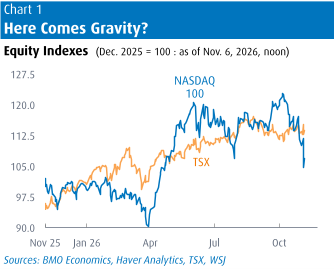
- Second, the dramatic pullback in tech stocks—which saw the biggest single-day drop in market cap on record last Thursday and the Nasdaq reach official correction terrain—has at least raised some doubts on Fed rate hikes.
- Lastly, Canada’s labour market also showed further signs of cooling. The day after the Budget, employment data landed with something of a dull thud, with the economy shedding 4,700 jobs in October. While monthly employment figures are notoriously volatile, this marked the third consecutive decline and left employment just 0.1% higher than a year earlier. More notably, the unemployment rate climbed another two ticks to 6.7%, despite very little growth in the labour force, which is actually lower than it was a year ago.
Switching gears, let’s return to last week’s historic decline in technology and AI-related stocks. The group bounced back this week but remains volatile, particularly given the events unfolding at NVIDIA. We’ll come back to that shortly. First, it is worth considering some of the potential portfolio implications if the AI theme continues evolving away from infrastructure investment and toward monetization and productivity.
- The balance between AI spenders and AI suppliers may begin to shift. The “picks-and-shovels” beneficiaries of the AI buildout, including semiconductor companies, cooling and electrical equipment providers, data-centre operators, and power infrastructure businesses, have been among the market’s biggest winners. Those companies could face a more challenging environment if the pace of AI capital spending begins to moderate. Think GE Vernova, Caterpillar, and similar infrastructure beneficiaries. Conversely, hyperscalers and large cloud providers could become relatively more attractive if existing capacity becomes increasingly valuable and investors begin rewarding stronger free cash flow and greater capital discipline. Think Amazon.
- The next generation of AI winners may increasingly emerge outside technology. While the infrastructure-building phase may be maturing, the adoption of AI across the broader economy still appears to have a long runway. Investor attention may increasingly shift toward businesses capable of using AI to improve productivity, enhance customer experiences, and reduce costs. Healthcare, financials, and industrials could all be meaningful beneficiaries of this next stage of the AI cycle.
- Market leadership could continue to broaden. Mid-cap stocks and the equal-weight S&P 500 may benefit if investor attention gradually shifts away from the relatively narrow group of companies that led the AI rally. Given the concentration within today’s market-cap- weighted indexes, a broader earnings recovery could create opportunities in areas of the market that have lagged during the AI-driven advance.
- Valuations are becoming more compelling. While many investors already have sizeable allocations to technology, the recent pullback may be creating opportunities for portfolios that remain underexposed to the sector. The Nasdaq’s forward price-to-earnings ratio has fallen to its lowest level since 2020 and now sits below both its five- and 10-year averages. More notably, the technology sector now trades roughly in line with the broader market, compared with its historical premium of approximately 20%.
Valuation alone is unlikely to act as an immediate catalyst, and confidence in the sector may take time to rebuild. Still, the correction has meaningfully reset expectations and, in our view, created a more attractive starting point for long-term investors.
Turning to the elephant in the room... NVIDIA. The sudden resignation of Jensen Huang has understandably created a period of uncertainty for NVIDIA, given the outsized role he played in shaping the company’s strategy and positioning it at the centre of the AI boom. Long-time CFO Colette Kress has stepped in as interim CEO, providing some continuity while the board searches for a permanent successor, although questions around leadership and governance are likely to keep volatility elevated in the near term. Importantly, however, a leadership change does not immediately alter NVIDIA’s technology, product roadmap, customer relationships or the enormous amount of AI infrastructure already built around its ecosystem, and the company has said it expects operations and customer commitments to continue without interruption. For long-term investors, we believe there is merit in looking through the immediate headline risk and allowing the underlying business fundamentals and upcoming results to determine the investment decision rather than reacting to the leadership shock alone. The next major test will be NVIDIA’s November 17 earnings report, which should provide a much clearer indication of whether the fundamental AI demand story remains intact despite the turmoil at the top.
As we discussed last week, we believe the AI theme is changing rather than ending. Investor attention is increasingly shifting from how much capital is being spent on AI infrastructure toward how effectively that investment can translate into profitability, productivity, and ultimately returns on capital. That transition is likely to bring additional volatility and broader market leadership, but it may also make the AI cycle more durable by giving monetization an opportunity to catch up with investment.
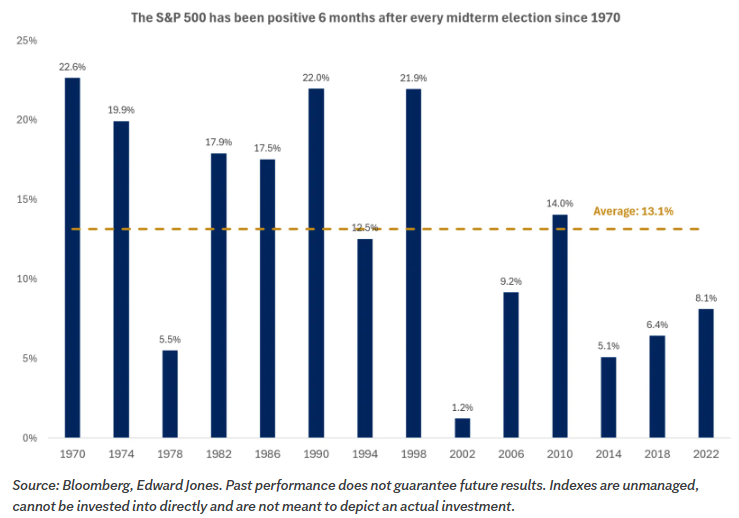
For investors, the key takeaway, in our view, is diversification rather than dramatic portfolio changes. We shared this data point last week, but folks at Edward Jones did a great job of putting this data into a chart. Edward Jones found that since 1970, the S&P 500 has generated positive returns in the six months following all 14 midterm elections, with an average gain of 13%. While history doesn’t repeat, but often rhymes, (and the usual disclaimer that past returns aren’t indicative of future performance) this chart offers a useful reminder that investors have generally been better served by remaining disciplined through periods of uncertainty than by reacting to election results, headlines, or short-term market swings.
Sources: BMO Capital Markets Economic Research Talking Points: A Decade in a Week
The opinions, estimates and projections contained herein are those of the author as of the date hereof and are subject to change without notice and may not reflect those of BMO Nesbitt Burns Inc. ("BMO NBI"). Every effort has been made to ensure that the contents have been compiled or derived from sources believed to be reliable and contain information and opinions that are accurate and complete. Information may be available to BMO Nesbitt Burns or its affiliates that is not reflected herein. However, neither the author nor BMO NBI makes any representation or warranty, express or implied, in respect thereof, takes any responsibility for any errors or omissions which may be contained herein or accepts any liability whatsoever for any loss arising from any use of or reliance on this report or its contents. This report is not to be construed as an offer to sell or a solicitation for or an offer to buy any securities. BMO NBI, its affiliates and/or their respective officers, directors or employees may from time to time acquire, hold or sell securities mentioned herein as principal or agent. NBI will buy from or sell to customers securities of issuers mentioned herein on a principal basis. BMO NBI, its affiliates, officers, directors or employees may have a long or short position in the securities discussed herein, related securities or in options, futures or other derivative instruments based thereon. BMO NBI or its affiliates may act as financial advisor and/or underwriter for the issuers mentioned herein and may receive remuneration for same. A significant lending relationship may exist between Bank of Montreal, or its affiliates, and certain of the issuers mentioned herein. BMO NBI is a wholly owned subsidiary of Bank of Montreal. Member-Canadian Investor Protection Fund. Any U.S. person wishing to effect transactions in any security discussed herein should do so through BMO Nesbitt Burns Corp.