MWW - AI Isn’t Slowing Down. It’s Growing Up.
DHL Wealth Advisory - Nov 06, 2026
- Investment Services
- Portfolio Management
- Special Reports and Newsletters
- Total Client Experience
- Wealth Management
Markets were reminded this week that even strong bull markets rarely move in a straight line. After an extended period of strength, Global Equities experienced a sharp reset Thursday, with the S&P 500 falling 4.36% and the technology-heavy Nasdaq...
Markets were reminded this week that even strong bull markets rarely move in a straight line. After an extended period of strength, Global Equities experienced a sharp reset Thursday, with the S&P 500 falling 4.36% and the technology-heavy Nasdaq Composite declining 5.52%, its worst session since April 2025. Much of the pressure was concentrated in technology and AI-related shares as investors reassessed elevated valuations and the enormous amount of capital being committed to AI infrastructure.
While a one-day decline of this magnitude can understandably feel uncomfortable, history suggests that periods of aggressive selling have often created attractive opportunities for patient investors. Large daily declines tend to occur when fear and forced selling are elevated, which can push prices down considerably faster than underlying fundamentals change. One historical study notes that following the S&P 500's ten worst single-day declines since 1981, the index was higher by double digits one year later in all but one instance. Corrections may be unpleasant, but historically they have often rewarded investors willing to look through the volatility rather than react to it.
Importantly, the broader economic backdrop remains constructive. The U.S. economy grew at a 3.4% annualized rate in the third quarter, accelerating from 2.2% in Q2, with investment and consumer spending contributing to the expansion. This reinforces our view that the current market weakness looks more like a repricing of expectations and valuations than a deterioration in the underlying economy. At the same time, declining bond yields during periods of equity weakness can provide an important valuation tailwind, particularly for growth companies whose valuations are more sensitive to long-term interest rates.
Diving a little deeper into the source of the market selloff this week: AI, or SI as we are apparently calling it these days. Following the blue wave in Tuesday’s US Mid Term election, investors took focus on what this would mean for a party that hasn’t sung to the same tune as their Republican counterparts. Many of these Democrats ran on a campaign against the rapid pace of data center build.
We think the more balanced interpretation is that the data-centre buildout is likely to continue, but become increasingly selective, economically rational and focused on projects with secure power, attractive returns and genuine demand. Texas alone represents roughly one-quarter of planned U.S. data-centre capacity, while several enormous projects are already under construction. Importantly, industry analysis suggests that 2027 construction schedules are largely already locked in, meaning the greater uncertainty surrounds projects planned for 2028 and beyond rather than an abrupt halt in near-term spending. Put another way, if there’s a shovel in the ground, the build continues.
The political debate should also be viewed with some perspective. Gina Hinojosa, Texas's governor-elect, clarified this week that she is "not ruling data centers out," but wants protections in place for communities, electricity grids and water supplies before development continues at the same pace. She also emphasized that Texas intends to remain a pro-business state. Meanwhile, newly elected Texas Senator James Talarico has advocated minimum standards around grid reliability, environmental impacts, employment and greater transparency rather than an outright federal prohibition on data-centre development.
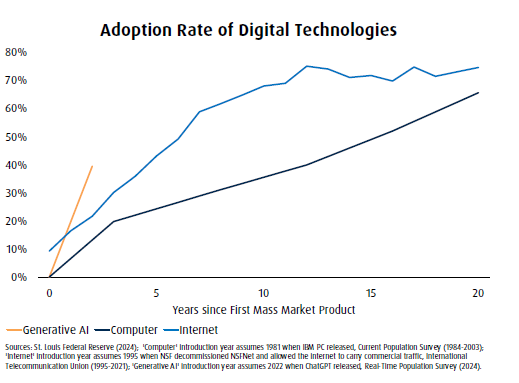
The bottom line is this: AI/SI is here to stay – no matter what happens to the pace of data center buildout or how chip stocks trade this month. End-user demand is definitely NOT a problem since it is ramping faster than any other technology in recent (perhaps human) history. Generative AI hit 40% penetration in barely a year, a feat that took PCs more than a decade to achieve (chart).
Similarly, the price of compute (measured in tokens) is declining quickly, helping propel (and/or fund) more use cases as companies and individuals become hooked on the ability to automate rote knowledge work and crunch through large, laborious data sets in a matter of minutes (chart). Companies are simply NOT going to risk losing their competitive position to pause or withdraw their use of AI.
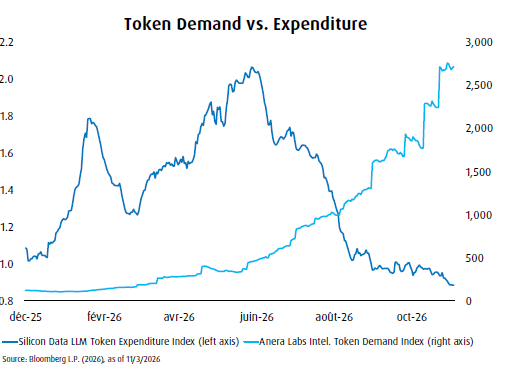
While end-user demand isn’t in question, many aspects of the ability to fulfill it are. For decades, electricity usage had been relatively stagnant, providing little reason to substantially upgrade or expand the electric grid’s capacity. However, the nearly parabolic curve of demand that has erupted in the wake of agentic AI’s introduction has changed that, necessitating rapid increases in the infrastructure required to support AI model training and use. Plant expansions, reshoring efforts and the shift to automated manufacturing (e.g., robots, autonomous pick-and-pack machines, forklifts) exacerbate the energy requirements.
Data centers have been around for years (they’re what powers the cloud after all). It has been a unique hurdle, however, to secure sufficient land and local regulatory approvals plus the materials, production machinery, components and memory/advanced processing chips required to build the type of facilities needed to train and operate complex AI models. Labor skilled enough to build them has also been in short supply.
The AI buildout is being primarily funded by the private sector (as were other innovations such as railroads and energy infrastructure). Industry players such as the large hyperscalers (Microsoft, Alphabet, Meta, Amazon, Oracle) and frontier model creators (e.g., OpenAI, Anthropic, xAI) are competing in an existential race to build relationships, market share and an ability to reliably service end markets.
Announced plans to build data centers have scaled quickly, though according to Bloomberg up to half may be delayed and/or have been rolled back. While Wall/Bay Street often convert delays or issues into all-or-nothing thinking, it’s more nuanced than that for the hyperscalers and model creators. Not building compute capacity isn’t an option, so roadblocks in one area necessitate redirecting and rethinking and possibly moderating the pace. Despite obstacles, retrenchment is not likely.
Leveling of the torrid pace of data center build, particularly if it’s an industry-wide issue, may actually help on several fronts. Shortages of core components like memory chips have spiked inflation that has spilled over to other parts of the economy. Intel, for example, saw its stock price decline nearly 30% on a single day last week when it announced its most recent quarter was negatively impacted by the high price of PCs that slowed consumer demand more than anticipated. A leveling of demand for such parts could lead to a decrease in upward price pressure and allow production of those components to catch up. An added benefit of reducing price pressure could filter through the broader economy, giving the U.S. Federal Reserve more wiggle room to watch and wait versus launching multiple rate hikes.
From an investment perspective, greater discipline may ultimately be healthy for the AI cycle. Instead of every proposed project automatically receiving capital, developers may increasingly need to demonstrate access to power, adequate water and infrastructure, committed customers and acceptable economic returns. That could eliminate some speculative projects while allowing well-capitalized hyperscalers and strategically important developments to move forward. One industry expert noted that Texas could lose some speculative projects without losing its position as a major AI infrastructure hub. It’s also worth pointing out that there’s no shortage of jurisdictions outside of the US that would love the inflow of capital to build out these projects. There’s a lot of cheap hydro and empty space in parts of Canada...
For markets, that distinction matters. A shift from indiscriminate spending toward more selective capital allocation is very different from the end of AI investment. The enormous requirement for computing capacity, semiconductors, electricity generation, transmission, cooling and networking infrastructure does not disappear because permitting becomes more rigorous. In our view, a more measured buildout could actually extend the investment cycle by directing capital toward projects with the strongest economics and reducing the risk of the blatant overbuilding that has undermined previous technology investment cycles.
The AI infrastructure story seems to have moved from a “build everything” to “build what makes economic sense.” We view that evolution as a sign of a maturing investment cycle, not necessarily the end of one.
Definitive answers are hard to come by in what is by rights still a nascent industry. The scramble to build capacity, and develop end markets, solid client relationships and durable business models is fraught. Volatility in the last few months has reset valuations, suggesting many of the darkest fears may already be priced in – but the long-term opportunity less so. A healthy broadening of market participation seems to be underway, at the same time filtering down to smaller companies. We maintain our belief that a solidly performing economy, employed consumers and a continued steady pace of AI and infrastructure buildout should benefit investors who have long time horizons.
Our view remains constructive. Volatility may persist and there is no guarantee Thursday represents the bottom, but significant pullbacks can create opportunities to selectively add to high-quality businesses at more attractive valuations. Put simply, when prices fall much faster than fundamentals, long-term investors should be looking for opportunities, not just
reasons to worry.
Sources: Weekly Strategy Perspectives – A BMO Private Wealth Publication: The Muddy Middle; "Managing Volatility: Top 10 Stock Market Drops & Recoveries", Hartford Funds Publications, 2026.
The opinions, estimates and projections contained herein are those of the author as of the date hereof and are subject to change without notice and may not reflect those of BMO Nesbitt Burns Inc. ("BMO NBI"). Every effort has been made to ensure that the contents have been compiled or derived from sources believed to be reliable and contain information and opinions that are accurate and complete. Information may be available to BMO Nesbitt Burns or its affiliates that is not reflected herein. However, neither the author nor BMO NBI makes any representation or warranty, express or implied, in respect thereof, takes any responsibility for any errors or omissions which may be contained herein or accepts any liability whatsoever for any loss arising from any use of or reliance on this report or its contents. This report is not to be construed as an offer to sell or a solicitation for or an offer to buy any securities. BMO NBI, its affiliates and/or their respective officers, directors or employees may from time to time acquire, hold or sell securities mentioned herein as principal or agent. NBI will buy from or sell to customers securities of issuers mentioned herein on a principal basis. BMO NBI, its affiliates, officers, directors or employees may have a long or short position in the securities discussed herein, related securities or in options, futures or other derivative instruments based thereon. BMO NBI or its affiliates may act as financial advisor and/or underwriter for the issuers mentioned herein and may receive remuneration for same. A significant lending relationship may exist between Bank of Montreal, or its affiliates, and certain of the issuers mentioned herein. BMO NBI is a wholly owned subsidiary of Bank of Montreal. Member-Canadian Investor Protection Fund. Any U.S. person wishing to effect transactions in any security discussed herein should do so through BMO Nesbitt Burns Corp.