MWW: Tech Earnings: Trick or Treat. The Steroid Version
DHL Wealth Advisory - Oct 30, 2026
- Investment Services
- Portfolio Management
- Special Reports and Newsletters
- Total Client Experience
- Wealth Management
The pullback in AI-related stocks gathered momentum this week, with the Philadelphia Semiconductor Index falling roughly 5%, taking its October decline to approximately 20%. The weakness continued to weigh on the Nasdaq, now down more than 6% for the
The pullback in AI-related stocks gathered momentum this week, with the Philadelphia Semiconductor Index falling roughly 5%, taking its October decline to approximately 20%. The weakness continued to weigh on the Nasdaq, now down more than 6% for the month, while technology-heavy international markets were also hit hard. China’s CSI 300 has slipped into bear-market territory, while South Korea’s Kospi is now roughly 50% below its June peak.
Aside from the valuation leveling, there has been a lot of rotation under the hood. Case in point: 87% of the S&P 500 Composite Index constituents have suffered pullbacks greater than 15%. Over one-third (36%) have declined 30% or more. The Russell 2000 Index (a proxy for small cap stocks) has seen 62% of its members decline by 30% or more. In other words, markets have done a great job of rapid, rolling resets without dragging the entire index down simultaneously.
Diving a bit deeper, the weakness in technology has not developed into a broad-based equity sell-off. Instead, investors have rotated toward more defensive areas of the market, with utilities, consumer staples and healthcare helping cushion the decline in the major indexes. One clear beneficiary of the AI sell-off has been the bond market. The benchmark U.S. 10-year Treasury rallied sharply last week, pulling its yield down from a recent high of 5.3% to around 4.90% in Friday trading.
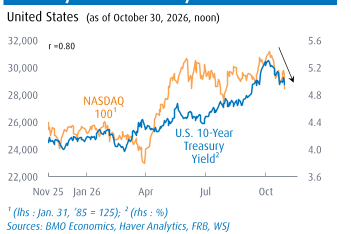
Taking a step back, equities have generated strong returns this year and many major markets are within 5-7% of record highs. That said, these are the factors that we continue to monitor.
* Persistently high energy prices and stubborn inflation;
* Elevated central-bank rates and longer-term bond yields; and
* Growing questions about whether the enormous AI investment cycle can be sustained.
Let’s take a closer look at these risks and, more importantly, the indicators we will be watching as they develop.
Energy and inflation remain closely linked: Ongoing conflict in the Middle East continues to complicate the outlook for oil. Drone attacks on Saudi Arabia last week by the Iran-backed Houthi militia pushed crude prices to their highest level since May, while reports suggest the U.S. could consider renewed military action in the region following the midterm elections.
Higher oil prices are already making their way into global inflation data. Consumers have remained surprisingly resilient despite the additional pressure on household budgets, although the latest retail-sales numbers showed some early signs of fatigue.
Encouragingly, energy flows through the Strait of Hormuz have recovered to prewar levels. If that continues, it could remove some pressure from energy prices, inflation and household finances. Still, any renewed escalation in the region bears watching, particularly if it produces another substantial move higher in oil.
Higher rates remain another pressure point: The recent jump in global interest rates has also raised concerns that tighter financial conditions could slow economic activity or expose stress among more heavily indebted borrowers. Bond yields have retreated from their recent highs but remain elevated. For context, the US 10-year is now ~8% lower from highs reached in mid-October.
Against this backdrop, the U.S. Federal Reserve elected to leave the federal funds rate unchanged following its September increase, despite a couple of policymakers favouring another hike. Chair Warsh maintained a firm stance on returning inflation to target, but his comments also suggested the Fed may be willing to proceed patiently, echoing the tone of several recent Fed speakers.
A more deliberate Fed could be reassuring for investors. Policymakers are trying to strike a difficult balance: keeping rates restrictive enough to bring inflation under control without tightening so aggressively that they undermine economic growth. At this stage, we expect another rate increase in December, followed potentially by one additional move in 2027.
AI enthusiasm meets a reality check: The biggest market story this week, however, was the reassessment of the AI investment and earnings cycle.
Capital spending by AI hyperscalers has soared, accompanied by increased borrowing. These companies now represent approximately 10% of investment-grade corporate bond issuance this year, compared with only 0.5% in 2024, and that share could increase further in 2027. Recent earnings reports have done little to eliminate concerns about the growing capital requirements. Meta, Google and Amazon, for example, all delivered encouraging revenue results , but its plans to accelerate AI investment were poorly received by investors and contributed to a sharp sell-off in the shares.
Despite the correction, we still see reasons for optimism. Near-term earnings trends across AI-related businesses remain strong, while valuations have already reset meaningfully lower this year. That valuation adjustment should help alleviate at least some of the concerns surrounding an AI-driven market bubble.
Looking further out, the fundamental argument for AI remains compelling. Continued advances in the technology have the potential to generate meaningful productivity gains across the broader economy. The bigger questions are how large those gains ultimately become, how quickly they materialize and which companies emerge as the primary beneficiaries.
Fundamentals still matter: While it is important to recognize these risks, it is equally important not to lose sight of the underlying economic picture.
The U.S. economy continues to look resilient. Friday’s first estimate of third-quarter GDP is expected to show an impressive 3.2% annualized gain, based on Bloomberg consensus expectations. That would point to continued economic momentum, while business surveys such as the Purchasing Managers Index suggest the strength carried into the fourth quarter.
The early read on earnings season supports the constructive tone. Although only 48% of S&P companies have released Q3 results, revenue growth is over 12%, which has translated into 26% earnings growth. Notably, all 11 sectors have participated and produced positive top- and bottom-line growth. Simply put, companies are continuing to deliver profits, and that earnings strength remains an important pillar supporting equity markets.
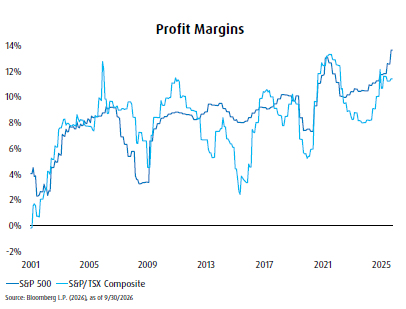
The recent rotation in markets appears to reflect a reassessment of the sustainability of AI investment at a time when inflation and interest rates remain elevated. With investors attempting to price these competing forces, further volatility in the coming weeks would not be surprising. We remain constructive on the longer-term outlook for equities, but believe diversification has become increasingly important. Against that backdrop, we continue to favour exposure across both large- and mid-cap companies, providing broader participation across sectors, market capitalizations and investment themes. The goal is not to avoid areas such as technology or AI, but rather to ensure that no single theme becomes large enough to dictate overall portfolio outcomes.
After several years of strong equity returns, periods of volatility should not come as a surprise. We often say that corrections are a natural part of a healthy functioning market, although they rarely feel that way when you are in the middle of one. Maintaining a diversified portfolio aligned with long-term objectives and risk tolerance remains one of the most effective ways to navigate those inevitable bumps in the road. History has repeatedly shown that periods of uncertainty can ultimately create opportunities, and we continue to believe that patient investors who remain focused on the fundamentals will be rewarded over time.
Sources: BMO Capital Markets Economic Research: BMO Economics Talking Points: Tech Earnings: Trick or Treat, Steroid Version
The opinions, estimates and projections contained herein are those of the author as of the date hereof and are subject to change without notice and may not reflect those of BMO Nesbitt Burns Inc. ("BMO NBI"). Every effort has been made to ensure that the contents have been compiled or derived from sources believed to be reliable and contain information and opinions that are accurate and complete. Information may be available to BMO Nesbitt Burns or its affiliates that is not reflected herein. However, neither the author nor BMO NBI makes any representation or warranty, express or implied, in respect thereof, takes any responsibility for any errors or omissions which may be contained herein or accepts any liability whatsoever for any loss arising from any use of or reliance on this report or its contents. This report is not to be construed as an offer to sell or a solicitation for or an offer to buy any securities. BMO NBI, its affiliates and/or their respective officers, directors or employees may from time to time acquire, hold or sell securities mentioned herein as principal or agent. NBI will buy from or sell to customers securities of issuers mentioned herein on a principal basis. BMO NBI, its affiliates, officers, directors or employees may have a long or short position in the securities discussed herein, related securities or in options, futures or other derivative instruments based thereon. BMO NBI or its affiliates may act as financial advisor and/or underwriter for the issuers mentioned herein and may receive remuneration for same. A significant lending relationship may exist between Bank of Montreal, or its affiliates, and certain of the issuers mentioned herein. BMO NBI is a wholly owned subsidiary of Bank of Montreal. Member-Canadian Investor Protection Fund. Any U.S. person wishing to effect transactions in any security discussed herein should do so through BMO Nesbitt Burns Corp.