MWW - 4-Years Young
DHL Wealth Advisory - Oct 16, 2026
- Investment Services
- Portfolio Management
- Special Reports and Newsletters
- Total Client Experience
- Wealth Management
Happy Anniversary! Not words we have used to open our weekly comment before, but alas, there is a first time for everything. This week marks the fourth anniversary of the current bull market, which began on October 12, 2022.
Happy Anniversary! Not words we have used to open our weekly comment before, but alas, there is a first time for everything. This week marks the fourth anniversary of the current bull market, which began on October 12, 2022. Back then, the backdrop was considerably less celebratory. The S&P 500 had fallen roughly 25% from its peak, inflation was running above 8%, and the Federal Reserve was in the midst of one of its most aggressive rate-hiking campaigns in decades.
Four years later, the picture looks very different. The S&P 500 has recorded 124 all-time highs, including 28 this year alone, while overcoming a series of events that, at various points, threatened to bring the rally to an end. Investors have navigated the 2023 regional banking stress, the 2024 yen carry-trade unwind, the 2025 tariff-driven correction and, this year, renewed geopolitical tensions and volatile oil prices. Canadian equities have joined in the advance, helped by resilient economic growth, rising corporate profits and improving commodity prices.
Yet despite everything that has changed, investors are still wrestling with many of the same questions they were asking four years ago. Will inflation remain contained? Where will interest rates eventually settle? And can the economy continue to outperform expectations?
With that in mind, let's take a look at how this bull market compares with its predecessors, what has made this particular cycle different, and where the next chapter might take us.
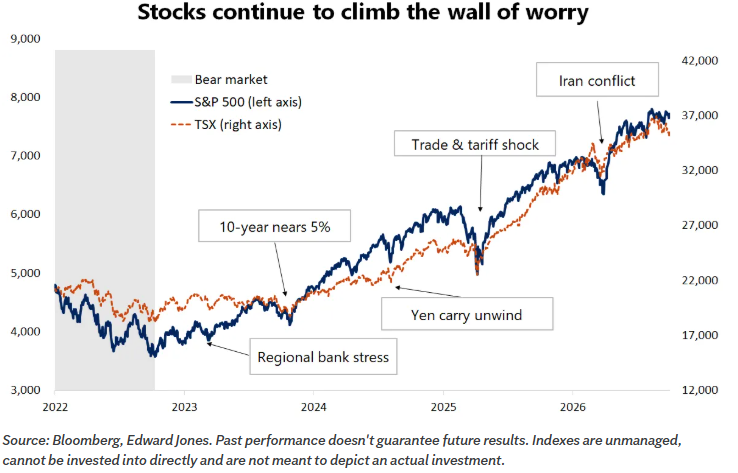
Since the October 2022 low, the S&P 500 and TSX have more than doubled, returning 130% and 119%, respectively, including dividends. Those are impressive gains, but in the context of history, they are not necessarily extraordinary.
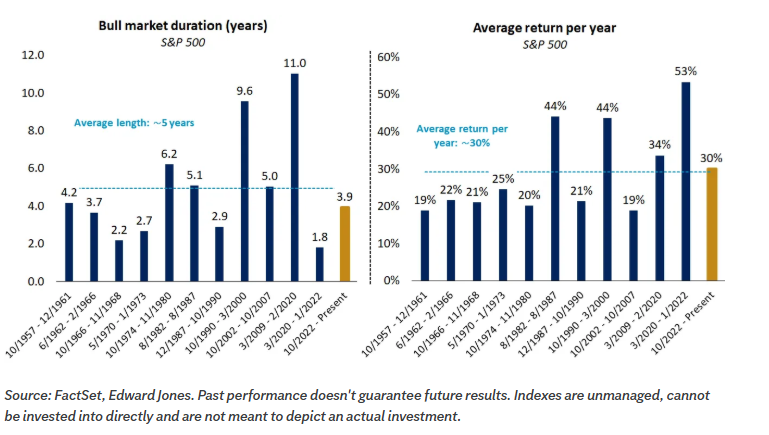
Over the past 70 years, the 11 U.S. bull markets preceding this one generated an average price return of roughly 150% and lasted about five years. More than half, six of 11, made it beyond their fourth birthday. The longest, stretching from 2009 to 2020, survived for nearly 11 years. Canadian bull markets have typically had a somewhat shorter lifespan of roughly three to four years, while producing average gains of approximately 92%.
So, while this bull market is certainly no longer a youngster, neither does four years qualify it as particularly old. What stands out is less how far it has travelled and more the environment it has travelled through.
Many previous bull markets were accompanied by rising optimism and speculation. This one has spent a good portion of its life doing the opposite: climbing a seemingly endless wall of worry.
The early stages of the bull market were dominated by recession forecasts that ultimately failed to materialize. An inverted yield curve added credibility to those concerns, with the spread between 10- and 2-year Treasury yields remaining negative through much of 2022, 2023 and 2024. Historically, the yield curve has been a useful warning signal for recessions. This time around, however, it appears increasingly likely to join the relatively short list of false alarms.
Rather than rolling over, the economy proved substantially more resilient than many expected. Real GDP growth exceeded the commonly cited 2% long-term trend in the U.S. in each of the past three years and averaged roughly 2% in Canada. Strong consumer spending, healthy labour markets, fiscal support and a surge in business investment helped keep the expansion going. Higher borrowing costs certainly took their toll on interest-rate-sensitive areas such as housing, but strength elsewhere in the economy was enough to offset much of that weakness.
Meanwhile, investors have had no shortage of other issues to worry about. The war in Ukraine, tariffs, conflict in the Middle East and AI-related supply constraints have all contributed to inflation pressures and complicated the outlook for central-bank policy. Yet the resilience of the economy may help explain something that initially appeared contradictory: higher interest rates alongside higher stock prices. Stronger growth can support corporate earnings while simultaneously keeping inflation and interest rates higher.
For much of the past four years, investors have asked when rates would finally return to the ultra-low levels of the previous decade. Perhaps the better question is whether those levels were ever particularly normal to begin with.
In a world characterized by elevated government borrowing, enormous capital-investment requirements and the potential for stronger productivity growth, interest rates may ultimately settle above the levels investors became accustomed to during the 2010s. And then there is AI.
Since the launch of ChatGPT in 2022, advances in artificial intelligence have occurred at a remarkable pace. The resulting investment boom across the AI supply chain has provided a meaningful boost to U.S. economic activity while also dramatically reshaping stock-market leadership. A relatively small group of mega-cap technology companies has generated a disproportionate share of market returns, leaving the S&P 500, and the U.S. equity market more broadly, increasingly concentrated. What separates the current environment from some previous episodes of market concentration, however, is that much of the leadership has been supported by very strong earnings growth.
In that respect, concentration may be less of a bug and more of a defining feature of this cycle. That doesn't mean it should be ignored. When a growing share of the market relies on a small group of companies, disappointment from even one or two of those leaders can have an outsized impact on the broader index.
To put the concentration into perspective, roughly 40 cents of every dollar invested in the S&P 500 is allocated to its ten largest companies, with approximately eight cents invested in NVIDIA alone. NVIDIA's market value now exceeds that of five entire S&P 500 sectors: Energy, Utilities, Real Estate, Consumer Staples and Materials. It is also worth more than the entire U.S. small-cap market.
While this concentration is most visible south of the border, and something we have discussed extensively in recent weeks, Canadian investors have also benefited from the broader AI investment boom. Demand for energy, power infrastructure and critical resources required to support the buildout provides another avenue for participation beyond owning the technology leaders themselves.
Another interesting feature of this bull market has been the reluctance of many investors to fully embrace it.
As money-market yields climbed, the appeal of sitting in cash increased considerably. With investors suddenly being paid to wait, cash balances remained elevated and many stayed on the sidelines even as equity markets continued moving higher. Participation has broadened over the past two years, but we have yet to see the type of widespread enthusiasm normally associated with the latter stages of a major bull market.
In many ways, this has been a bull market that investors have spent four years waiting to end rather than celebrating while it lasted.
Looking ahead, the Fed and the BoC will likely play leading roles in determining what happens next. History tells us that bull markets rarely die simply because they have reached a certain age. More often, the end comes when monetary policy becomes overly restrictive, the economy falls into recession, or a combination of the two.
No single indicator will provide the answer, which is why we continue to watch credit spreads, market breadth, changes in leadership and investor sentiment for evidence that risks beneath the surface are beginning to build.
Admittedly, earnings growth is unlikely to maintain its current pace, and the market is approaching a full year without a 10% pullback despite such corrections occurring regularly throughout history. However, if you look under the hood of these major indices, you’ll see a number of sectors have already witnessed such a correction in recent weeks. Again, something we wrote about last week. Going forward, investors should maintain realistic expectations for both returns and volatility. A healthier market would ultimately benefit from broader participation beyond today's leaders. Managing concentration risk, including within AI-related investments, may become increasingly important as this cycle matures.
In our view, a growing economy, rising corporate profits, and central banks that may be looking to tap the brakes rather than slam on them suggest this bull market still has room to run. Earnings do not need to continue growing at today's exceptional pace for stocks to move higher. Continued profit growth, coupled with stable or modestly improving valuations if inflation and interest-rate pressures ease, could support further gains. If so, we may very well be opening another weekly comment with these words at this time next year.
Sources: BMO Economics, The Yield Curve... Again, September 27, 2024.
The opinions, estimates and projections contained herein are those of the author as of the date hereof and are subject to change without notice and may not reflect those of BMO Nesbitt Burns Inc. ("BMO NBI"). Every effort has been made to ensure that the contents have been compiled or derived from sources believed to be reliable and contain information and opinions that are accurate and complete. Information may be available to BMO Nesbitt Burns or its affiliates that is not reflected herein. However, neither the author nor BMO NBI makes any representation or warranty, express or implied, in respect thereof, takes any responsibility for any errors or omissions which may be contained herein or accepts any liability whatsoever for any loss arising from any use of or reliance on this report or its contents. This report is not to be construed as an offer to sell or a solicitation for or an offer to buy any securities. BMO NBI, its affiliates and/or their respective officers, directors or employees may from time to time acquire, hold or sell securities mentioned herein as principal or agent. NBI will buy from or sell to customers securities of issuers mentioned herein on a principal basis. BMO NBI, its affiliates, officers, directors or employees may have a long or short position in the securities discussed herein, related securities or in options, futures or other derivative instruments based thereon. BMO NBI or its affiliates may act as financial advisor and/or underwriter for the issuers mentioned herein and may receive remuneration for same. A significant lending relationship may exist between Bank of Montreal, or its affiliates, and certain of the issuers mentioned herein. BMO NBI is a wholly owned subsidiary of Bank of Montreal. Member-Canadian Investor Protection Fund. Any U.S. person wishing to effect transactions in any security discussed herein should do so through BMO Nesbitt Burns Corp.