MWW - Cdn. Jobs: Not Just Surviving, But Thriving...Wait, What?
DHL Wealth Advisory - Aug 07, 2026
- Investment Services
- Portfolio Management
- Special Reports and Newsletters
- Total Client Experience
- Wealth Management
It was a record week for North American benchmarks as equity markets rallied on the back of a very strong earnings season. The rally was broad based compared to the gains we saw in June, which were largely centered in the semi-conductor trade.
It was a record week for North American benchmarks as equity markets rallied on the back of a very strong earnings season. The rally was broad based compared to the gains we saw in June, which were largely centered in the semi-conductor trade. While that sector is still down ~30% from their June highs, the rest of market did the heavy lifting this week for investors as funds flowed back into other areas of technology, financials, and materials.
At this point, most of the Mag7 companies have reported (Magnificent 7 represented by Apple, Alphabet, Amazon, Meta, Microsoft, NVIDIA and Tesla), with mixed market reactions. Microsoft and Amazon shares rallied following stronger cloud-computing revenue, while Meta's stock price moved lower as markets focused on an earnings miss and softer guidance amid elevated capital spending. Apple shares also declined as cost concerns and the company's cautious outlook appeared to disappoint investors.
The broader takeaways were that AI investment remains a durable theme, as several companies raised their capital-expenditure outlook, although share-price performance is beginning to diverge more meaningfully, in our view. We believe this represents an important shift in the AI investment cycle. Markets appear to be moving from rewarding companies for AI spending to assessing the revenue and earnings that these investments can generate. This shift could raise the bar for companies with aggressive investment plans. Large technology companies may have the balance sheets, cash flows and access to capital to sustain elevated spending, but investors appear more likely to scrutinize the timing of returns more closely.
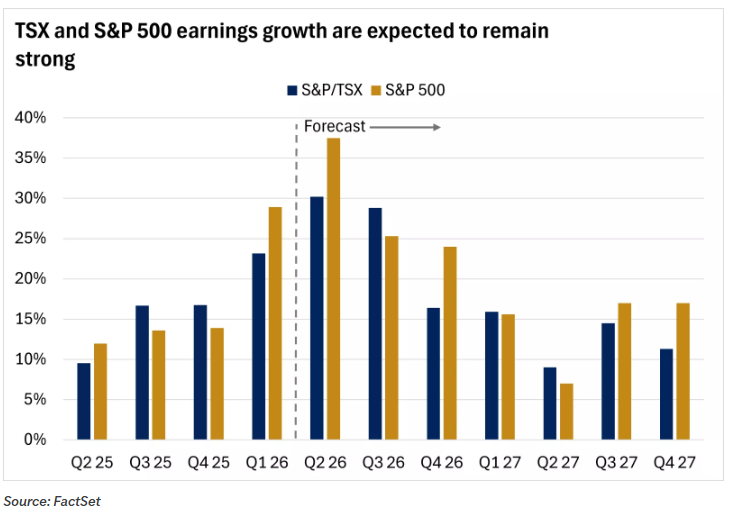
More broadly, second-quarter results have been strong. More than halfway through earnings season, 86% of the S&P 500 companies that have reported have beaten analyst estimates, with an average upside surprise of 31%. As a result, forecasts for second-quarter earnings growth have been revised sharply higher to 37%, up from 22% at the end of the quarter. Energy companies have posted the strongest growth — supported by higher oil prices during the quarter — followed by the communications and consumer discretionary sectors. Earnings gains have also been broad-based, with 10 of the 11 sectors reporting year-over-year increases. S&P/TSX earnings have also been solid, with 64% of companies exceeding estimates by an average upside surprise of 3.4%.
We believe wider participation in earnings growth could help make the market's advance more durable by reducing its reliance on a small group of mega-cap companies. It could also help create a more favourable backdrop for diversified portfolios. Earnings growth is expected to remain strong, supported by a steady labour market, resilient economic growth, and health consumer spending, shown in the chart below:
Elsewhere, this morning we had Canadian employment figures that defied the skeptics by jumping 75,100 in July, extending a series of surprisingly solid results after a stumbling start to the year. Details were not quite as impressive as the rollicking headline tally, but still quite firm overall.
The Bank of Canada will view this report as a further tightening in the job market. First, the unemployment rate dipped yet again by a tick to 6.4%. That's down a half a point just since the spring, and compares to the nearby high of 7.1%, hit as recently as last September. To put that in perspective, the labour force has only grown by 91,200 people over the past year, or less than 8,000 a month—so it doesn't take much in the way of job gains to carve down that jobless rate.
Bottom Line: Landing on day of a soft U.S. payroll result, the contrast with Canada's surprisingly upbeat reading is stark. Not unlike the GDP bounce from weakness at the turn in the year, the job figures are very much echoing the rebound. But, perhaps also like the GDP results, the recent job growth likely exaggerates the underlying strength in the economy. Even with the flashy headlines, we suspect that the yearly trend in both is more indicative of economic reality—job growth of just under 1% y/y and GDP growth of just under 2% y/y. Still, the big July gains are a hint of building momentum after the Q2 rebound, even as trade uncertainty still looms over the outlook. With wage growth taming further and energy prices more moderate, the BoC won't take on a more hawkish tone yet, though a strengthening economic backdrop could eventually push them in that direction if it persists.
Meanwhile, our neighbours to the south also had their July Employment report, but the results were quite different. The report was bad enough on the job creation front that it will get the US Federal Reserve (FOMC) and markets thinking once again about the labor market side of the Fed’s dual mandate—especially if we get another tame CPI inflation report next week. It will definitely take the air out of the rate-hike trade and raise the odds of another hold at the next FOMC meeting in September.
In the aftermath of today’s US jobs report, Fed funds futures were only placing a 39% chance of a rate hike in September, down from 57% the day before. BMO’s economics team maintains their baseline forecast of no rate hikes for this year. Many consumers will continue to struggle with average hourly earnings growth more visibly falling behind rising prices, and new jobs getting harder to come by as the Midterm elections rapidly approach.
Sources: BMO Capital Markets Economic Research- BMO Economics EconoFACTS: Cdn. Employment (July)
The opinions, estimates and projections contained herein are those of the author as of the date hereof and are subject to change without notice and may not reflect those of BMO Nesbitt Burns Inc. ("BMO NBI"). Every effort has been made to ensure that the contents have been compiled or derived from sources believed to be reliable and contain information and opinions that are accurate and complete. Information may be available to BMO Nesbitt Burns or its affiliates that is not reflected herein. However, neither the author nor BMO NBI makes any representation or warranty, express or implied, in respect thereof, takes any responsibility for any errors or omissions which may be contained herein or accepts any liability whatsoever for any loss arising from any use of or reliance on this report or its contents. This report is not to be construed as an offer to sell or a solicitation for or an offer to buy any securities. BMO NBI, its affiliates and/or their respective officers, directors or employees may from time to time acquire, hold or sell securities mentioned herein as principal or agent. NBI will buy from or sell to customers securities of issuers mentioned herein on a principal basis. BMO NBI, its affiliates, officers, directors or employees may have a long or short position in the securities discussed herein, related securities or in options, futures or other derivative instruments based thereon. BMO NBI or its affiliates may act as financial advisor and/or underwriter for the issuers mentioned herein and may receive remuneration for same. A significant lending relationship may exist between Bank of Montreal, or its affiliates, and certain of the issuers mentioned herein. BMO NBI is a wholly owned subsidiary of Bank of Montreal. Member-Canadian Investor Protection Fund. Any U.S. person wishing to effect transactions in any security discussed herein should do so through BMO Nesbitt Burns Corp.