MWW - Market's Odyssey
DHL Wealth Advisory - Jul 24, 2026
- Investment Services
- Portfolio Management
- Special Reports and Newsletters
- Total Client Experience
- Wealth Management
After a near 11% rally this year, the S&P 500 took a breather this week, down over 1%. The Canadian TSX was also down modestly for the week in local currency terms. Underneath the surface, U.S. markets are seeing more rotation, both among sectors...
After a near 11% rally this year, the S&P 500 took a breather this week, down over 1%. The Canadian TSX was also down modestly for the week in local currency terms.
Underneath the surface, U.S. markets are seeing more rotation, both among sectors and within sectors. At the sector level, we have seen AI-driven sectors like technology underperform, while more cyclical and defensive areas have held up better. This has been the case not only over the last week, but since early June.
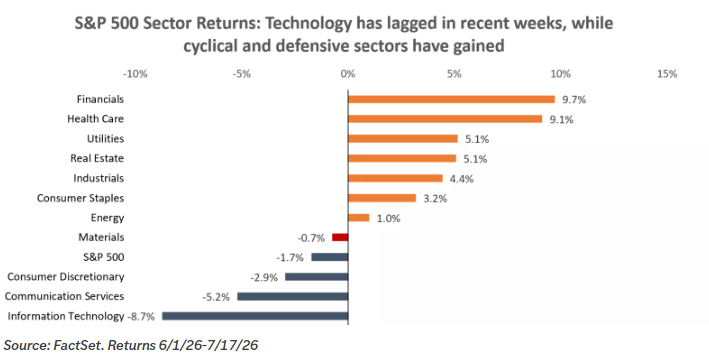
The parts of the market that had the sharpest rallies earlier this year, including semiconductor stocks, have seen the biggest pullbacks as well. This is not too surprising, given that parabolic moves in the market tend not to be sustainable – as there is some natural profit-taking and consolidation that brings these sub-sectors down again.
Earnings growth has been a bright spot for corporations all year. As we enter Q2 earnings season, S&P 500 earnings growth forecasts have been revised substantially higher, from about 14% year-over-year to currently around 25%. Similarly, Canadian TSX earnings growth estimates have gone from about 15% to 30% for the second quarter.
The upward revisions have been driven mostly by the energy, and in the U.S. both energy and technology sectors have contributed to the higher earnings growth estimates.
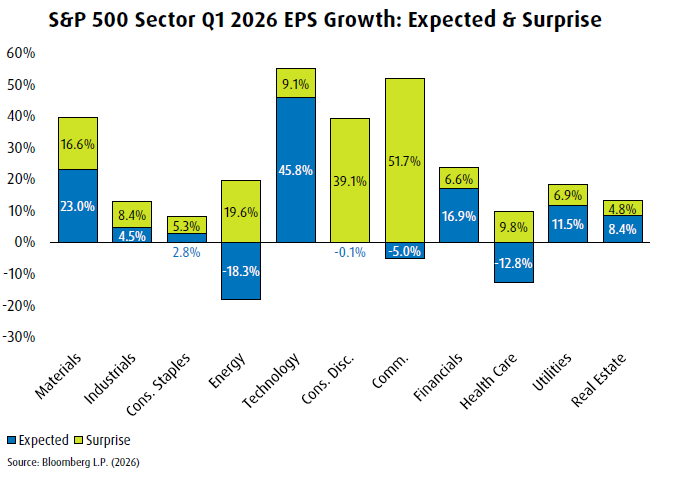
Thus far, aggregate first quarter earnings topped even the most optimistic estimates. The S&P 500, for example, grew earnings at a 28% clip versus the 13% that consensus had projected when the period started. And it wasn’t just AI or AI-adjacent companies: eight of 11 sectors produced double-digit earnings growth. Materials, consumer discretionary, tech and communication services boasted bottom-line upturns of better than 40%. All 11 sectors generated better than projected results.
As companies continue to report earnings this quarter, investors will be watching for clues on whether earnings growth is sustainable, especially in the U.S. technology sector. In particular, there are three questions worth monitoring in the upcoming S&P 500 earnings season:
- What is the growth of AI capex spending going forward? This year, AI capex spending is expected to grow a stellar 75% to between $700 and $800 billion. However, in the next year or two, the pace of this growth will likely slow, with forecasts calling for 25% growth in 2027 and 6% in 2028. If we hear companies reaffirm this guidance, or even exceed it, tech stocks and the semiconductor sector in particular may respond positively.
- Are technology companies seeing sufficient revenue gains from the AI capex spend? Investors will also be watching to see if the companies that are spending on capex, hyper-scalers like Meta and Alphabet, report stronger revenues or point to returns on these investments. If they can justify the spending with better returns, investors will likely reward them accordingly.
- What is the state of the consumer? Finally, investors will be watching to see if the U.S. consumer remains healthy. Thus far, the large banks have reported, including J.P. Morgan, Citi, and Goldman Sachs, and all have pointed to resilient loan growth, credit quality and spending. Consumption is a key driver of economic growth, and more signs of a solid consumer will be welcome for investors.
Bottom line: Q2 earnings season is setting up to be a meaningful one in the U.S. and Canada. In the U.S. technology sector, investors are looking for trends on AI capex spending and return on this investment. More broadly, the bar for earnings growth is set relatively high, but if companies can deliver – and reaffirm a solid outlook – this may be supportive of the ongoing earnings-driven market rally we've seen this year.
Overall, equity markets have had a solid year despite geopolitical uncertainty and rotation in the U.S. tech and AI sectors. The S&P 500 is now up about 9% for the year, and the Canadian TSX is up about 12%.
While we could continue to see rotation underneath the surface, the good news is that investor appetite for stocks remains robust. This is likely because earnings growth and economic growth continues to deliver. Over the next few weeks, earnings season will gear up and trading may well be volatile against a backdrop of double-digit market performance to date and buoyant expectations for outsized earnings progress. Healthy earnings prospects are broad based despite the perception that a handful of hyperscalers are driving the bus. Thus, those names may have undue influence on short-term markets on report days if results don’t meet (or more likely excessively beat) consensus expectations. However, any pullbacks represent repositioning opportunities. We would not view them as an indication of a bubble bursting nor disruption of the solid long-term trends currently in motion.
Sources: Weekly Strategy Perspectives – A BMO Private Wealth Publication / Perspectives
The opinions, estimates and projections contained herein are those of the author as of the date hereof and are subject to change without notice and may not reflect those of BMO Nesbitt Burns Inc. ("BMO NBI"). Every effort has been made to ensure that the contents have been compiled or derived from sources believed to be reliable and contain information and opinions that are accurate and complete. Information may be available to BMO Nesbitt Burns or its affiliates that is not reflected herein. However, neither the author nor BMO NBI makes any representation or warranty, express or implied, in respect thereof, takes any responsibility for any errors or omissions which may be contained herein or accepts any liability whatsoever for any loss arising from any use of or reliance on this report or its contents. This report is not to be construed as an offer to sell or a solicitation for or an offer to buy any securities. BMO NBI, its affiliates and/or their respective officers, directors or employees may from time to time acquire, hold or sell securities mentioned herein as principal or agent. NBI will buy from or sell to customers securities of issuers mentioned herein on a principal basis. BMO NBI, its affiliates, officers, directors or employees may have a long or short position in the securities discussed herein, related securities or in options, futures or other derivative instruments based thereon. BMO NBI or its affiliates may act as financial advisor and/or underwriter for the issuers mentioned herein and may receive remuneration for same. A significant lending relationship may exist between Bank of Montreal, or its affiliates, and certain of the issuers mentioned herein. BMO NBI is a wholly owned subsidiary of Bank of Montreal. Member-Canadian Investor Protection Fund. Any U.S. person wishing to effect transactions in any security discussed herein should do so through BMO Nesbitt Burns Corp.
