Investment Insights, Summer 2026
Szego Jones Lawrence Wealth Management - Jun 16, 2026
Our Summer 2026 newsletter, “A Shifting (Energy) Landscape?,” briefly looks at how supply concentration risks and geopolitical uncertainty may be reshaping the global landscape.
In This Issue
- Pain at the Pump: Psychology of Gas Prices
- The New Rules of Digital Deception
- Lesser-Known FHSA Tips
- The Democratization of Stock Ownership
- Geopolitical Shocks: The Norm, Not the Exception
A Shifting (Energy) Landscape?
The average person today has nearly 700 times more useful energy at their disposal than their 19th-century counterpart.1 This vast expansion of energy access has been the foundation of modern prosperity, largely invisible in daily life — as is its vulnerability to disruption.
In the mid-1960s, crude oil surpassed coal as the world’s dominant fossil fuel, marking the beginning of a structural dependence that persists today. Global consumption now exceeds 100 million barrels per day, up from around 60 million just a half-century ago. Although the global energy mix has gradually diversified, the world remains 80 percent dependent on fossil fuels.
The conflict with Iran has served as an abrupt reminder of energy’s central role in global order. In the spring, the Strait of Hormuz exposed the risks of routing roughly 20 percent of global supply through a single chokepoint. The resulting disruptions not only drove fossil fuel prices sharply higher but also reinforced a consequence that extends well beyond economics: energy security is inseparable from national security.
This is not a new lesson. During the 1973 oil embargo, while Canada largely avoided the severe shortages and long gas lines seen in the U.S., supply shocks triggered a sharp surge in inflation, with delayed policy responses creating broader economic instability. That experience laid the groundwork for a new energy strategy built on diversifying away from Middle East supply and strengthening domestic capacity. As a result, while Canadians faced higher prices at the pump, the effects were less severe than in many import-dependent nations, particularly in Southeast Asia.
Will this accelerate a broader energy shift? Indeed, recent events have prompted many nations to revisit their energy strategies, with renewed interest in alternative energy sources aimed at reducing dependence on imported fossil fuels. At the same time, expectations of a rapid decline in fossil fuel use may be optimistic. Even as efficiency improves, total oil demand has proven remarkably resilient. A key constraint is the efficiency paradox, often described by the Jevons effect: efficiency improvements lower costs, but as costs fall, substitution and income effects tend to increase overall consumption. The substantial growth in air travel, even as fuel efficiency has substantially improved, illustrates the dynamic. Today, while energy use per unit of GDP has fallen over the past two decades, total energy consumption has not, and in the U.S., per capita energy use has only declined at around half the pace of efficiency gains.2
The conflict may also prove a catalyst for reshaping global dynamics. The UAE’s decision to leave OPEC in the spring, departing the cartel it joined in 1967, may signal emerging fractures in traditional alignments. As a key producer with significant spare capacity, the move could meaningfully alter OPEC’s ability to influence global oil supply and prices.
At the same time, in an era of heightened geopolitical uncertainty and renewed trade tensions, stability and reliability are commanding a growing premium alongside resource abundance. Canada’s role as a stable and proximate energy supplier reinforces its structural importance in global energy markets. This position shouldn’t be discounted, especially in an increasingly fragmented world. As one market observer noted at the height of the conflict, “oil and gas aren’t the only two commodities missing from world markets... so are trust and predictability.” Against this backdrop, Canada’s position has rarely looked stronger.
1. How the World Really Works, by Vaclav Smil, 2022;
2. https://www.eia.gov/todayinenergy/detail.php?id=48976; According to the EIA, U.S. per capita energy consumption peaked at 360 million BTU in 1979 and dipped below 300 million BTU in 2020.
Pain at the Pump: Psychology of Gas Prices
As gasoline prices rose in the spring, Google searches for “gasoline” reached their highest level in two decades.1
After years of elevated inflation following the pandemic, the latest price shock has come from gasoline, after oil prices rose by around 60 percent in April alone. The impact felt particularly acute because gasoline is a frequent, highly visible purchase, and for many households, one with few substitutes beyond public transit or car pooling. Yet a broader view offers perspective:
High prices may feel bad, but a longer view tells a familiar story. We’ve been here before. In June 2022, the national average hit $2.07/L, equivalent to $2.33/L in today’s dollars, with Vancouver at $2.52/L and St. John’s at $2.27/L. Prices also surpassed $2.00/L in 2008 (inflation-adjusted, chart). Over time, the long-term average has been close to $1.50/L.2
We need less. Over the decades, vehicle fuel efficiency has improved. In Canada, average consumption has fallen by roughly 10 to 15 percent, to around 8.6L/100km, from 9.5L/100km in the late 1990s, though efficiency gains have been offset by a shift toward bigger vehicles like SUVs.
It takes a smaller share of income. Rising incomes, combined with improved efficiency, mean fuel costs account for a smaller portion of household budgets. Gasoline accounts for 2.6 percent of average Canadian household expenditures, down from roughly 4.0 percent in 2011.3
Still, perception often matters as much as reality. Gas prices are posted prominently and updated frequently, making them salient in ways most prices are not.
Of course, none of this diminishes the strain on households, particularly those struggling with rising costs. Elevated energy prices are expected to continue feeding through supply chains, adding pressure to broader inflation. According to the International Energy Agency, global inventories have been drawn down at a record pace, creating at least a four-month lag before supply conditions can normalize. But the broader point remains: while gasoline prices fluctuate, our broader capacity to absorb the changes has improved.
1. www.wsj.com/economy/consumers/gas-just-hit-4-a-gallon-is-that-really-as-bad-as-it sounds-850545f3;
2. StatsCan T: 18:10-0001-01;
3. Latest figures available: 2019 from Fraser Institute, 2025 Energy Costs & Canadian Household Report; 2011 figures from 2016 report.
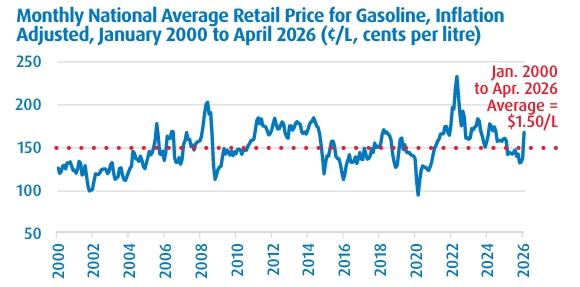
Sources: StatsCan T: 18-10-0001-01, adjusted for inflation, Bank of Canada inflation calculator, https://www.bankofcanada.ca/rates/related/inflation-calculator/
The New Rules of Digital Deception
“Never take candy from a stranger.” It was a warning many of us grew up with and one we might ironically long for today. Back then, the dangers seemed simpler. Now, recent commentary suggests a far more unsettling modern corollary: “Trust nothing.” 1
Scams have moved beyond isolated, one-off messages and evolved into coordinated systems designed to blend into everyday digital routines. According to McAfee’s 2026 Scamiverse Report, we now receive an average of 14 scam messages per day, and the average person spends 114 hours a year trying to determine what is real and what is fraudulent online.2 Despite increased public awareness, the growing sophistication of artificial intelligence (AI) has widened the gap between what people can reasonably detect and what scammers can convincingly disguise.
As a result, some people have stopped answering phone calls altogether. Even messages from seemingly familiar contacts can no longer be assumed authentic. For example, a newer form of phishing involves fake email “e-vites” from supposed friends. Because these messages often originate from compromised or convincingly spoofed accounts, recipients may trust them without hesitation. A user clicks an invitation link and is redirected to a page requesting email credentials in order to view or RSVP to the event. Once entered, those details are used to compromise email accounts, enable identity theft or harvest contact lists for further scams.
Traditional warning signs of scams remain a useful first line of defence, but they are no longer sufficient on their own. AI now allows bad actors to clone voices, mimic writing styles and generate fake pages at scale, making deception harder to spot because it’s engineered to feel familiar. In an increasingly complex scamiverse, several updated precautions are suggested, as adapted from McAfee’s “What Not to Do in 2026” list:
- Do not assume “no link” means safe; linkless scams are increasingly common;
- Do not act on urgency alone; pressure continues to be a key manipulation tactic;
- Do not scan random QR codes, especially in public spaces;
- Do not trust caller ID, photos or voices; all can be convincingly faked;
- Do not click account alerts sent via message; instead, access services directly on an official site;
- Do not share login or verification codes under any circumstances;
- Do not reuse passwords across accounts; one breach can cascade;
- Do not assume you’re too informed; modern scams are designed around that confidence.
Today, the new challenge is navigating a landscape where deception is designed to look routine. To learn how BMO works with you to keep accounts safe and for ideas to better protect yourself, visit the BMO Security Centre: https://www.bmo.com/en-ca/main/personal/security-centre/. As always, we will never contact you via unsolicited phone call, email, text or social media asking for sensitive information such as passwords, PINs or one-time passcodes.
If you have concerns, please reach out.
1. https://www.washingtonpost.com/business/2026/04/11/party-invite-scam-facebook-clone/;
2. https://www.mcafee.com/blogs/wp-content/uploads/2026/01/Scamiverse.pdf
Lesser-Known FHSA Tips
Think the First Home Savings Account (FHSA) is just for first time buyers? Here are lesser-known FHSA tips for seasoned investors — or to pass along.
- You may qualify even if you’ve owned a home before. If you haven’t owned a home in the current year and the preceding four calendar years, you may be eligible. While the FHSA is often seen as a tool for young buyers, “seasoned” investors who meet these criteria may consider the FHSA as a retirement savings boost (see point #6).
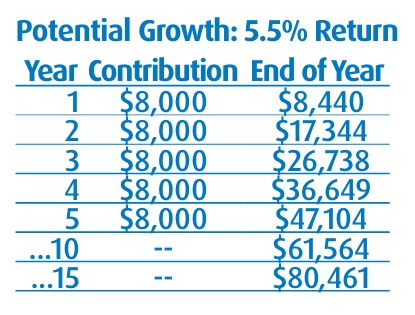
- Maximize contributions early for compounded growth. The FHSA allows annual contributions of up to $8,000, with a lifetime limit of $40,000. However, it must be closed by December 31 of the earliest of: i) the 15th anniversary of opening, ii) the year following the first qualifying withdrawal, or iii) the year the account holder turns 71. As such, not contributing the full $8,000 from the start risks missing out on the lifetime limit, tax-deductible benefits and potential for tax-free growth over time. Consider a scenario where an investor contributes $8,000 each year from the outset. At a 5.5 percent annual return, by year 5, the $40,000 contribution would grow to $47,104. By year 15, it could grow to over $80,000 (chart); all tax-free if withdrawn to purchase a first home
- Unused deductions can be claimed in future years — even after the account closes. Like a Registered Retirement Savings Plan (RRSP), FHSA contributions are tax-deductible, and unused deductions can be carried forward even after the FHSA closes. For those who expect to be in a higher tax bracket in future years, claiming the deduction later may be a valuable way to help optimize tax savings.
- Be aware that carry-forward rules differ from other registered plans. The FHSA provides $8,000 in annual contribution room, with unused amounts carried forward to the following year, but only to a maximum of $8,000 and subject to the lifetime limit of $40,000. Other registered accounts allow for all unused contribution room to carry forward each year. For example, an individual who opened an FHSA in 2024 and contributed $4,000 would have $12,000 in participation room in 2025. If they do not contribute in 2025, they would have $16,000 of participation room in 2026, not $20,000, as only $8,000 carries forward. Excess contributions are subject to a penalty of one percent per month.
- You can use the FHSA alongside the RRSP Home Buyers’ Plan (HBP). In 2026, the HBP allows withdrawals up to $60,000 from the RRSP for an eligible first-home purchase without tax consequences, subject to repayment rules. In the scenario above, if the FHSA grows to $80,000, alongside the HBP, this could result in $140,000 toward a first home.
- Transfer unused FHSA funds to an RRSP or RRIF. If you do not use the FHSA to purchase a first home, assets can be directly transferred to your RRSP or RRIF without immediate tax consequences. These transfers do not affect unused RRSP contribution room.
The Democratization of Stock Ownership
Equity market participation continues to grow. Here’s a brief look.
As rising housing costs have pushed homeownership out of reach for many, a recent Wall Street Journal article noted that Gen Z is increasingly putting money into the stock market instead.1 Similar patterns may be emerging among younger Canadians, with nearly 74 percent reporting at least one type of investment.2 Today, technological advances and structural shifts in the markets have reduced many traditional barriers to entry, making financial markets increasingly accessible. (Whether that encourages financial literacy or promotes speculation remains open to debate.)
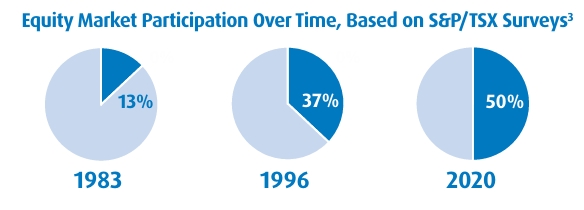
How have things shifted? By 2016, that figure had risen to nearly 24 percent. Today, roughly half of Canadians have some form of stock market exposure. While participation rates in Canada and the United States are comparatively high, global equity ownership remains uneven. As the barriers to entry continue to decline, what happens when the rest of the world catches up? The implications for global capital flows — and perhaps even valuation multiples — could be meaningful.
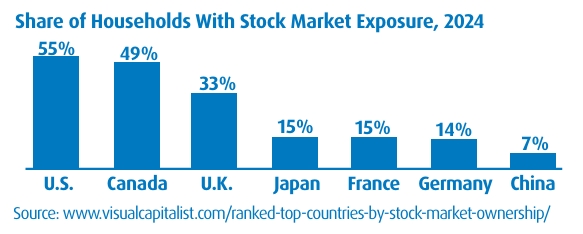
More broadly, the expansion of equity market participation has allowed a larger share of the population to benefit from one of the most powerful wealth-creation systems in modern economic history.
1. https://www.wsj.com/personal-finance/gen-z-investments-home-ownership-ec0bbe98;
2. https://www.finra.org/media-center/newsreleases/2023/finra-foundation-cfa-institute-research focuses-gen-z-investors;
3. https://www.cbc.ca/news/business/survey-says-almost-half-of-canadian adults-own-stocks-1.208778
Geopolitical Shocks: The Norm Rather Than the Exception
As the saying goes: “History is just one damned thing after another.”
We’ve been through a lot lately. Over the last five years, we’ve navigated a global pandemic, record inflation, the Ukraine/Russia war, tariff tensions and, now, the conflict in the Middle East. Through geopolitical shocks and adverse events, there may be certain takeaways for investors:
Adverse events are more common than we may recognize.
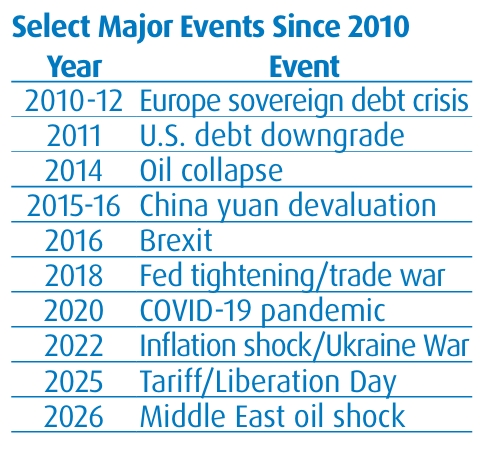
Geopolitical and adverse events are often more the norm than the exception. The chart below outlines select major events since the start of 2010. On average, a major disruption occurs roughly every couple of years.
Takeaway: Given this frequency, if investors were to wait for clarity before investing, they may spend more time on the sidelines than in the markets.
Recoveries can happen quickly, and often well before the event is over.
Over the past three decades, major shocks have led to average U.S. equity drawdowns of roughly six to seven percent, with markets typically bottoming within two to three weeks and recovering over the following month.1
Takeaway: Markets often do not wait for a crisis or adverse event to be resolved. After all, they are forward looking. By the time conditions feel “safe” again, a significant portion of the recovery may already have occurred.
Every crisis feels unique in the moment, but investor reactions are remarkably consistent.
It is natural to feel compelled to act when markets decline in response to these events. Our human instincts encourage us to seek safety and reduce uncertainty during periods of heightened volatility.
Takeaway: Of course, these risks are real and should not be ignored. Yet, investors also shouldn’t try to trade around every event. One of the most deliberate and effective actions investors can take is to remain committed to a well-constructed investment plan. This is why portfolios are diversified across sectors, geographies and asset classes, with a focus on quality, to provide resilience during periods of uncertainty and reduce the likelihood of being forced into reactive decisions. It also requires the discipline to recognize that, despite short-term declines in portfolio values, difficult periods eventually pass and markets resume their upward climb. In the year after the most significant geopolitical events, the S&P 500 posted an average gain of 14.2 percent (chart).
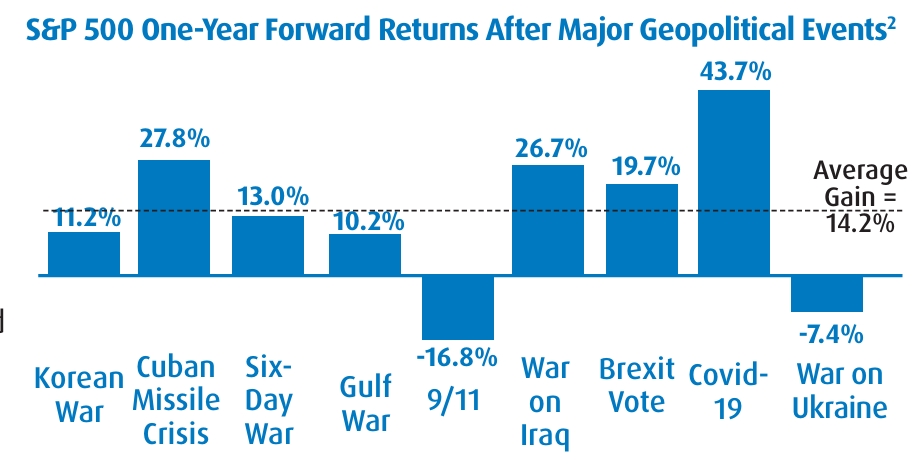
Time and again, we’re reminded that you can’t keep the markets down for too long. Even the darkest nights eventually give way to dawn, and staying the course may be one of the investor’s greatest advantages.
1. https://www.rbcwealthmanagement.com/en-ca/insights/then-and-now-market-reactions-to-military-conflicts-and-what-they-mean-today; https://www.principalam.com/us/insights/macro-views/markets-rebound-geopolitical-shocks-follow-familiar-script;
2. “Ignoring the Noise is Impossible,” March 20, 2026, A Wealth of Common Sense.
A Reminder: Risk Tolerance Doesn’t Change With the Markets
One of the questions we often hear from clients during prolonged periods of market strength is: How often should I change my risk tolerance? The answer: Not often.
Risk tolerance is an investor’s personal comfort level with financial risk. In simple terms, it reflects the ability to stomach market swings in exchange for potentially higher returns. Risk tolerance doesn’t tend to change dramatically over time. Consider the answer to this question: How would you respond to a 15 percent drop in your investments? Most people’s reactions and levels of comfort would likely not vary over time. This matters because such declines are not uncommon. Since the start of the millennium, the S&P/TSX has experienced three bear markets lasting a total of over 36 months, two with drops of over 45 percent.
Indeed, investing in equities is not without risk: market ups and downs, sometimes prolonged, are a natural part of the investing journey. While investment risk can never be eliminated, it can be managed. One of our primary roles as advisors is to act as risk managers, focused on preserving capital while growing it over time. We do this by constructing and managing portfolios to be resilient across different market outcomes, while still being positioned to perform well across the many paths markets may take. During buoyant periods, such as those we’ve experienced in recent years, it can be easy to get caught up in the momentum and overlook the value of risk management. Yet risk management is not about achieving the highest possible rate of return; it’s about preserving hard-earned capital and growing it over time to help investors achieve their goals. Often, it is only when markets decline that its value becomes more evident.
In practice, this approach is guided by a set of disciplined principles designed to control risk. This can be applied in several ways, including maintaining a strategic asset allocation, rebalancing portfolios when allocations drift too far from targets, limiting the size of any single holding, diversifying across sectors and geographies, and paying particular attention to an investor’s personal risk tolerance levels.
When Does Risk Tolerance Change?
As circumstances evolve, your capacity to take on financial risk may change. Risk capacity, or your ability to withstand a financial shock, can influence risk tolerance. Several factors can affect risk capacity, including:
- Major life events. Marriage or the birth of a child can lower your capacity for risk as you plan for large expenses, including a new home or a child’s education. Spouses often have different risk tolerance levels, so finding common ground is important when managing finances.
- Health-related events. Unexpected medical expenses or changes in your ability to generate income can alter your timeline and ability to achieve financial goals.
- Changes in income or net worth. Financial resources influence risk capacity. Higher discretionary income or savings can make it easier to weather market downturns without affecting lifestyle.
- Stage of life. As we age, risk capacity may decline. With fewer income sources or a need to preserve wealth for retirement, recovering from market volatility may become more challenging.
One Reason Not To Adjust: Fluctuations in the Markets
Your risk tolerance should not shift based on market conditions. Changing it in response to market performance is similar to trying to time the markets by buying and selling shares. It may be tempting to lower your risk tolerance after losses, or raise it during sustained gains, but market performance and emotions like fear or greed should not prompt a reassessment of your tolerance for risk.
If you have any questions about this, or any other investing matters, please call.
To Our Clients:
If things seem to be moving more quickly, you’re not mistaken. Blink, and the narrative seems to change. Inflation is front of mind as the impact of higher oil prices ripples through supply chains, contrasting earlier in the year when inflation appeared under control and markets priced in potential rate cuts. After the S&P 500 declined by roughly 10 percent by the end of March, it took just 11 trading sessions to make a full recovery in April. As one analyst noted, “for situation monitors, the whiplash is a thing to behold…for everyone else, they may not have even noticed.”
It is perhaps a useful reminder to focus less on the headlines this summer. For now, don’t underestimate the resilience of the economy or the consumer. As always, we are here to take care of your investing matters so you can slow down and enjoy the moments that matter.

Doug, Terri and Richard
BMO Private Wealth provides this publication for informational purposes only and it is not and should not be construed as professional advice to any individual. This newsletter was produced by J. Hirasawa & Associates, an independent third party for the individual Investment Advisor noted. While every effort is made to ensure that the contents have been compiled or derived from sources believed to be reliable and contain information and opinions which are accurate and complete, the author does not accept responsibility or liability resulting from the information or content provided. The information contained in this publication is based on material believed to be reliable at the time of publication, but BMO Private Wealth cannot guarantee the information is accurate or complete. Individuals should contact their BMO representative for professional advice regarding their personal circumstances and/or financial position. The comments included in this publication are not intended to be a definitive analysis of tax applicability or trust and estates law. The comments are general in nature and professional advice regarding an individual’s particular tax position should be obtained in respect of any person’s specific circumstances.
BMO Private Wealth is a brand name for a business group consisting of Bank of Montreal and certain of its affiliates in providing private wealth management products and services. Not all products and services are offered by all legal entities within BMO Private Wealth. Banking services are offered through Bank of Montreal. Investment management, wealth planning, tax planning, and philanthropy planning services are offered through BMO Nesbitt Burns Inc. and BMO Private Investment Counsel Inc. Estate, trust, and custodial services are offered through BMO Trust Company. Insurance services and products are offered through BMO Estate Insurance Advisory Services Inc., a wholly-owned subsidiary of BMO Nesbitt Burns Inc. BMO Private Wealth legal entities do not offer tax advice. If you are already a client of BMO Nesbitt Burns Inc., please contact your Investment Advisor for more information. BMO Nesbitt Burns Inc. is a Member – Canadian Investor Protection Fund and is a Member of Canadian Investment Regulatory Organization. BMO Trust Company and BMO Bank of Montreal are Members of CDIC. “BMO (M-bar roundel symbol)” is a registered trademark of Bank of Montreal, used under licence.