Fall 2026 Newsletter
Fortin Wealth Partners - Oct 08, 2026
Victory Lap for Diversification | Christine Fortin
Diversification didn’t make a comeback. It simply kept doing its job.
You may be thinking, yet another article on diversification. I get it. And you would somehow be correct in that the
punchline is that you need it.
However, often when we speak about diversifying, we are talking about long term – 10 year cycles or we reference history that some of us may or may not remember the specific critical points.
Every market cycle has its way of testing conviction and over the past several years, many investors found themselves asking a reasonable question: if a handful of mega-cap technology stocks were driving most of the market’s return, why own anything else? It was not an easy argument to defend over the last couple of years.
U.S. large-cap growth stocks, particularly the Magnificent Seven, delivered extraordinary results while many traditional diversifiers such as small-cap companies, international equities, dividend-paying businesses, and emerging
markets lagged behind. For advisors and investors committed to balanced portfolios, the pressure steadily mounted.
The challenge became especially pronounced as the end of 2024 approach and it was the time for annual rebalancing for institutional and retail investors alike. Disciplined investors were faced with doing something that often feels counterintuitive: trimming positions that had performed exceptionally well and reallocating capital toward areas of the market that had spent years underperforming.
Yet this is precisely where diversification earns its value.
The greatest threat to long-term investment success is rarely a recession, election, interest-rate decision, or geopolitical event. More often, it is our instinct to extrapolate recent experience indefinitely into the future. We naturally assume that what has been working will continue to work and that what has struggled will remain permanently out of favour.
History repeatedly reminds us otherwise.
The Broadening of Returns
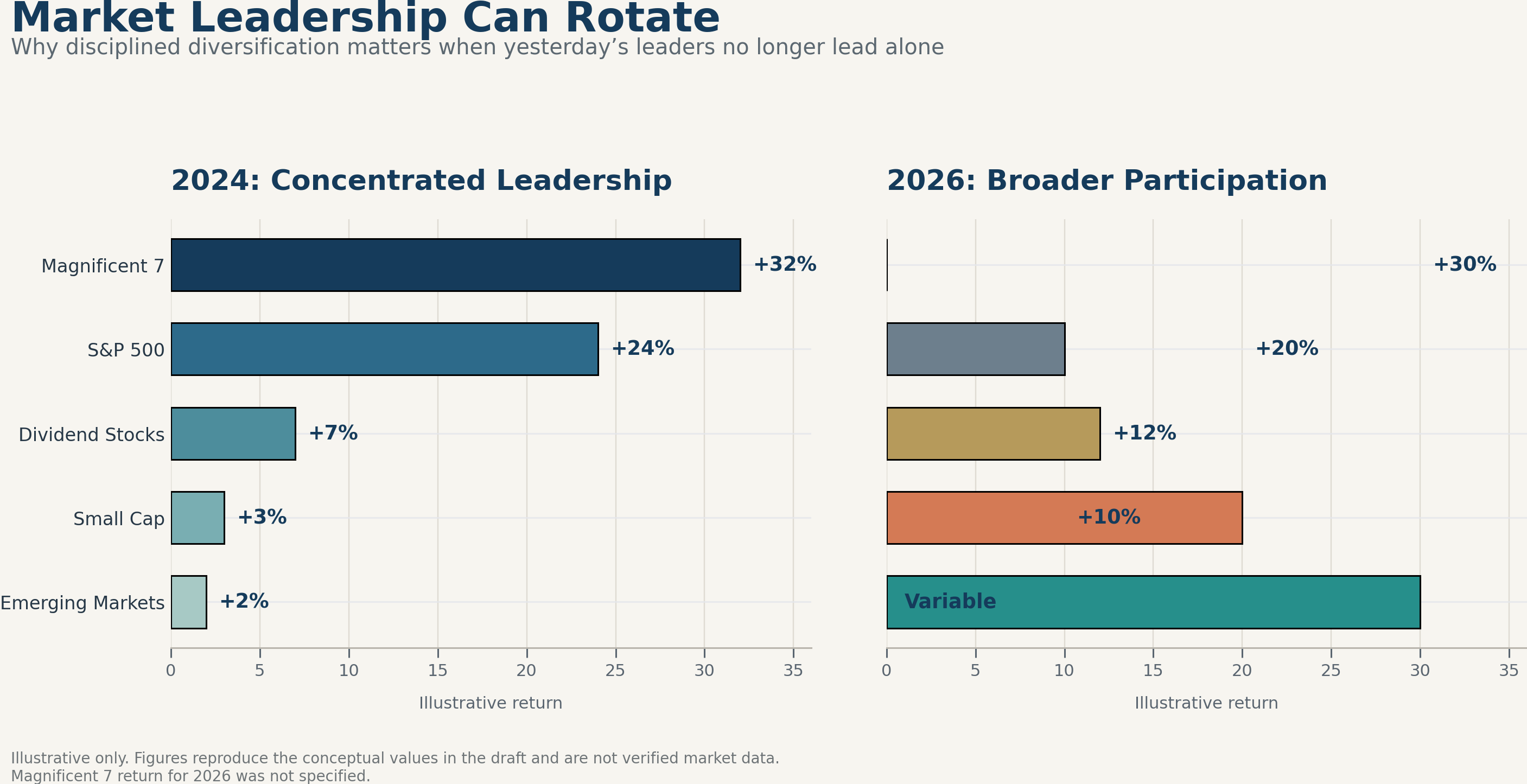
As we progressed through 2025 and into 2026, market leadership began to broaden.
While the largest technology companies remained important contributors to overall market performance, investors suddenly found opportunities emerging across a much wider range of asset classes and sectors. Small-cap equities recovered meaningfully. Emerging markets regained momentum. Dividend strategies and value-oriented companies began contributing positively once again.
The investment landscape shifted from being dominated by a handful of companies to one where a broader group of businesses participated in economic growth.
Sources
• Magnificent Seven proxy, MAGS ETF: 63.97% in 2024, 22.98% in 2025, and 5.09% in 2026 year to date. [financecharts.com]
• Russell 2000 Total Return Index: 11.54% in 2024, 12.81% in 2025, and 17.95% in 2026 year to date. [ycharts.com]
• S&P/TSX Composite proxy, XIC ETF: 21.48% in 2024, 31.53% in 2025, and 14.32% in 2026 year to date. [finance.yahoo.com], [ca.finance.yahoo.com]
For diversified investors, the results were notable.
Many of the portfolio components that had tested patience for years suddenly became meaningful contributors. What had appeared to be "dead money" was once again helping drive returns and improve portfolio
resilience.
That is not diversification suddenly working.
That is diversification working exactly as intended.
The Misunderstood Purpose of Diversification
Diversification is often judged by the performance of its weakest component.
That is a mistake.
The purpose of diversification is not to ensure every asset class outperforms at the same time. It is to ensure that a portfolio is not dependent on any single outcome, theme, sector, geography, or economic environment.
A diversified portfolio intentionally holds assets that will lead at different times.
When one area becomes dominant, another may lag. Eventually, leadership rotates.
The challenge is that most investors become dissatisfied with diversification just before it proves its worth. The winners are those who typically remain committed to the process rather than those who attempt to predict precisely
when that rotation will occur.
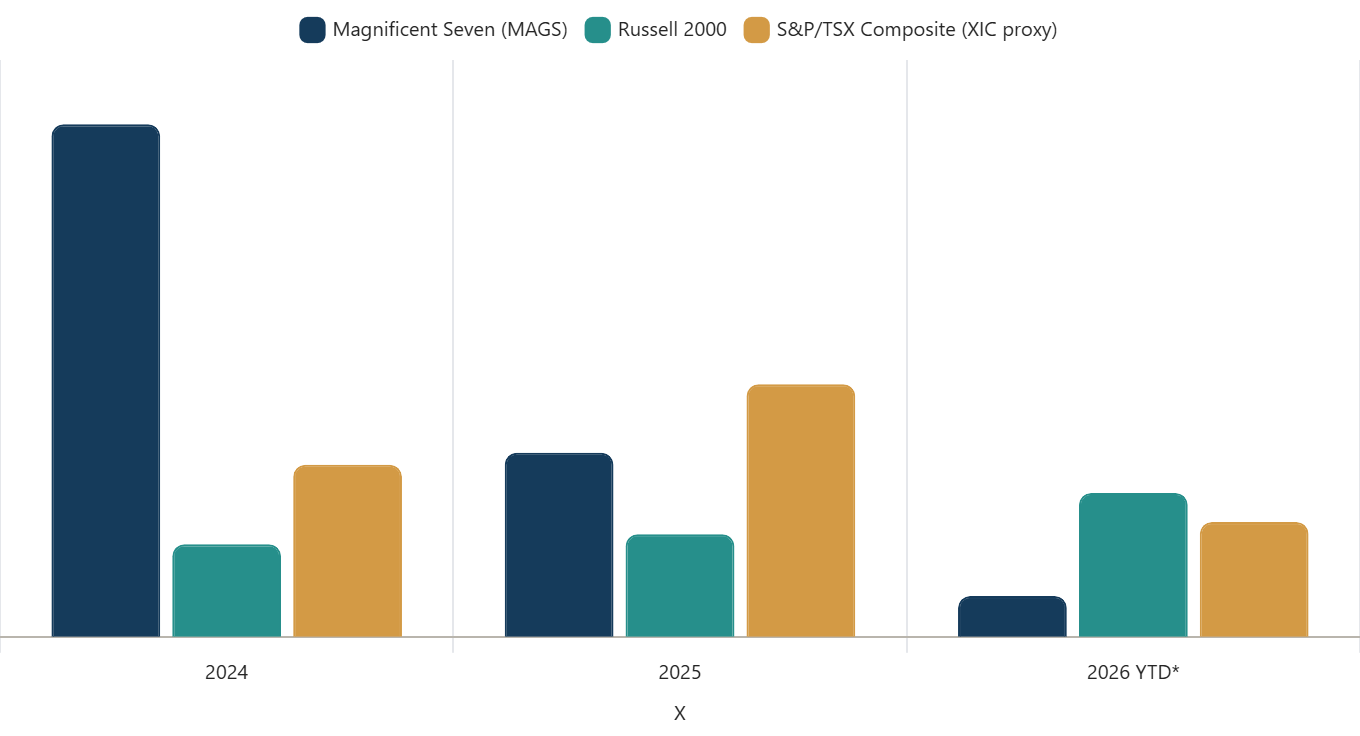
The below illustration tells us Market leadership rarely changes with advance notice. After dominating in 2024, the Magnificent Seven ceded leadership to broader areas of the market in 2025 and 2026, rewarding investors who stayed diversified rather than chasing yesterday’s winners.
Sources:
- Magnificent Seven proxy, MAGS ETF: 63.97% in 2024, 22.98% in 2025, and 5.09% in 2026 year to date. [financecharts.com]
- Russell 2000 Total Return Index: 11.54% in 2024, 12.81% in 2025, and 17.95% in 2026 year to date. [ycharts.com]
- S&P/TSX Composite proxy, XIC ETF: 21.48% in 2024, 31.53% in 2025, and 14.32% in 2026 year to date.
Valuation Still Matters
While market participation has broadened, valuations remain an important consideration.
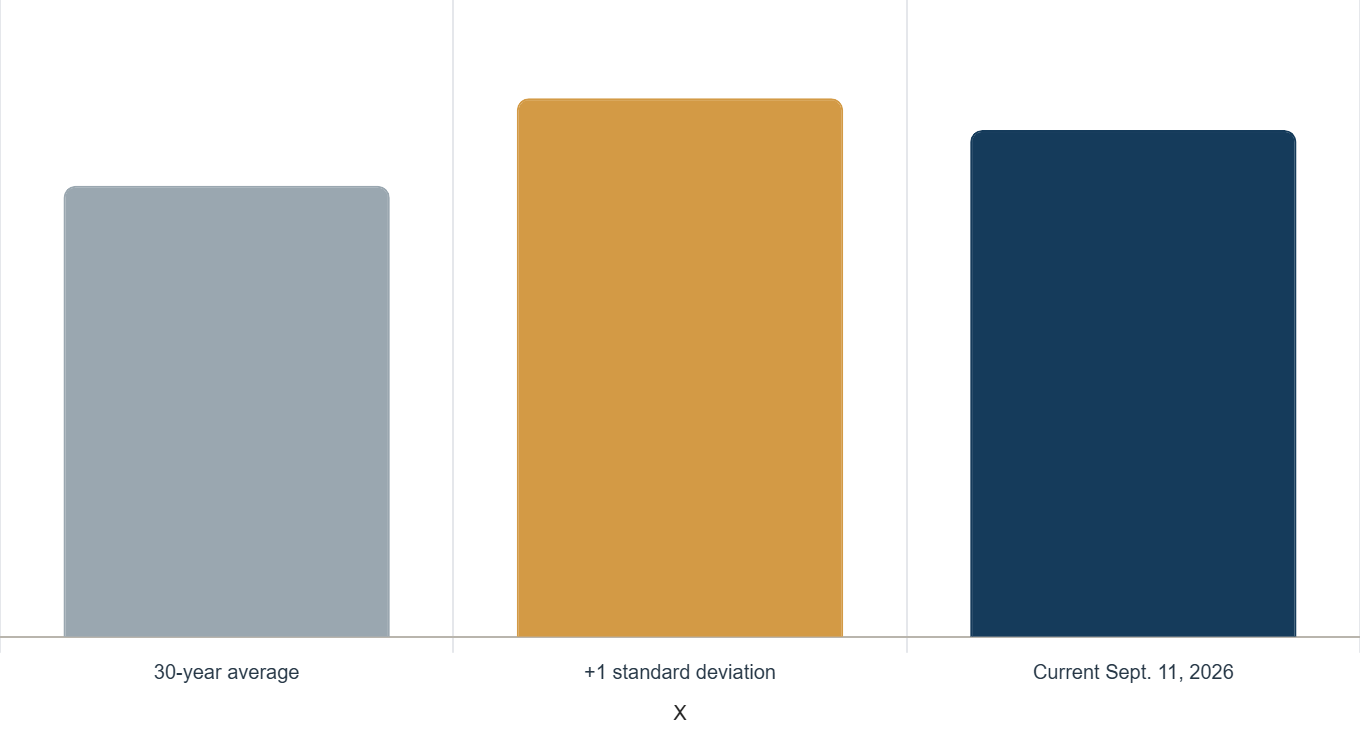
Today, U.S. equities continue to trade above long-term historical averages. That observation is not a forecast, nor does it suggest a market decline is imminent. It simply means that expectations remain elevated and that markets have less room for disappointment than they would at lower valuation levels.
The bullish argument is straightforward:
- Corporate earnings remain healthy.
- Business investment continues to support growth.
- Dividend payments continue to rise.
- Recession risks remain limited.
Those are all constructive developments.
At the same time, prudent investors recognize that markets rarely move in straight lines. Periods of volatility, corrections, and more meaningful drawdowns remain a normal and permanent feature of investing.
Sources
- The current forward 12-month P/E ratio of 19.1x is from FactSet Earnings Insight, dated September 11, 2026. FactSet also reports that the current multiple is below its five-year average of 19.8x and slightly above its ten-year average of 19.0x. [factset.com]
- The 30-year average of 17.0x and one-standard-deviation-above-average level of 20.3x come from JP Morgan Guide to the Markets - September, using data through August 31, 2026
The Real Lesson
If there is one lesson from the past two years, it is not that investors should abandon technology companies.
Nor is it that international markets, small and mid capitalization companies, or dividend strategies will necessarily outperform
from here.
The lesson is much simpler: portfolio construction matters.
The families we advise are not building wealth for the next quarter. They are building and preserving inflation adjusted wealth to support lifestyles, businesses, philanthropic endeavours, future generations and lasting legacies.
Those objectives are heavy burden on our team. We do not take those fiduciary responsibilities lightly. These objectives require more than identifying the latest investment trend.
They require resilience.
“Diversification is not a bet against success. It is a recognition that lasting wealth is built by participating in opportunity wherever it emerges. While ensuring that no single outcome determines your family’s future.”
Owning the Backbone of Change
From May 2026 + Fortin Wealth Infrastructure Private Equity Due Diligence Trip to Zurich.
I am reserving the right to re-post my previous white paper on what lies ahead of global economies and how we should be thinking about investment in the next decade.
I wrote this in April, based on my thoughts from Jan/Feb. I encourage those interested to give it another glance today, with the context of what we have seen so far with respect to planned investment in Canada – and ahead of the first ever
Canadian Investment Symposium.
** As I write, I am arranging travel to Zurich, to meet with the Private Equity Money Manager for Infrastructure investment that Mark Carney met with in Davos as he was creating his plan for Canada. This is a Due Diligence trip for Fortin Wealth. Boots on the ground. I will also be meeting with a leading global diversified Private Equity Manager out of Zug. Look for the results in our Winter Newsletter - or I am happy to chat about it anytime after my return mid October. I will also be meeting with Goldman Sachs’ top hedge managers early November and look forward to further discussing the tides of change on the
fixed income and hedge allocation front.
Sidebar on Tariff talk
We don’t need politicians to tell us everything will be fine.
There is nothing I can add or subtract from the daily rhetoric on Tariffs. We have discussed this extensively as part of our Investment Policies. There will be cost rises, and companies and families will need to be nimble and adaptable. We have sadly been warned.
Carney’s comments regardless of your political association, were at least honest. We don’t need politicians to tell us
everything will be fine, when it won’t.
When I read through transcriptions from his multiple speeches, many items are repeated. Specifically what stands out isn’t the measured tone (I would like to personally be able to tap into this side of myself), the factual data or the excellent points. It is the honesty. We are being told the truth. None of us are happy about it, but at least we know.
The escalation that would follow was not sugar coated.
There was no pretending there would be no consequences.
There was no trying to make a difficult situation seem easy.
Frankness that the dollar-for-dollar tariffs could raise costs for Canadians and reduce consumer choice while they are in place.
We are entering this with eyes wide open.
I haven’t seen many admissions like this in my time on earth. I have seen replays from WW2 leader comments that tell the straight truth about what they were facing, or were about to face. It was dire and it was direct.
Let’s be honest, it would have been far more politically convenient to tell all of us Canadians that the punishment would somehow run in only one direction.
I prefer to know what we are up against, and acknowledge the sacrifices that may be required and trust that I can handle that truth.
We shall see in time if that level of honesty was politically favourable for our current PM.
Data Centres: From Building the Foundation to Creating Value |Ryan Lidder
How the AI infrastructure cycle is evolving, and where the opportunities may shift next
Artificial intelligence is often described as a software revolution, but it runs on an enormous amount of physical infrastructure. Behind every AI model, cloud application, and digital transaction is a network of data centres filled with specialized computing equipment. Meeting AI’s demands has sparked one of the largest investment cycles the technology sector has seen. Five of the largest technology companies spent more than US$400 billion on capital expenditures in 2025, with a further
increase of roughly 75% expected in 2026, and McKinsey estimates global data-centre investment could reach about US$6.7 trillion by 2030. That capital is flowing into processors, networking, electrical systems, cooling, power generation, construction, and specialized real estate.
We believe this opportunity is unfolding in two broad stages: first, building the infrastructure, and second, putting it to productive use. Understanding that progression can help investors distinguish between the areas benefiting today and those that may matter more once the buildout matures.
Why AI Needs a New Generation of Data Centres
Traditional data centres were designed to store information, host websites, and run conventional business applications. AI is far more demanding. It requires thousands of specialized processors working together, moving vast amounts of data at high speed, while consuming significant electricity and generating substantial heat. The International Energy Agency (IEA) projects global data-centre electricity use will roughly double from about 415 TWh in 2024 to about 945 TWh by 2030, close to 3% of world electricity consumption, while the power density of AI servers rose roughly elevenfold between 2020 and 2025.2 As a result, the economic impact extends well beyond technology into utilities, industrials, engineering, real estate, telecommunications, and raw materials.
Phase One: Building the Infrastructure
Today’s clearest beneficiaries are the businesses supplying what a data centre needs before it can operate:
Phase Two: Putting the Capacity to Work
Once facilities are operational, the central question shifts from “How much capacity is being built?” to “How productively is it being used?” Cloud platforms will seek to recover their investments by selling computing power. Enterprise software may capture significant long-term value as businesses move AI from experimentation into daily workflows. Well-located data-centre real estate, particularly where power and approvals are scarce, may command premium value, while cybersecurity and data governance become ongoing operational needs. Ultimately, some of the biggest winners may sit outside technology entirely: manufacturers, healthcare providers, financial institutions, and logistics businesses that use AI to improve productivity.
The Two Phases at a Glance
Phase 1: Building Capacity | Phase 2: Using Capacity | |||
Key beneficiaries | Semiconductors, networking, electrical and grid equipment, cooling, engineering and construction | Cloud platforms, enterprise software, data-centre leasing, cybersecurity, and AI-enabled businesses across industries | ||
Revenue model | Largely tied to orders, deliveries, and installations | More recurring: subscriptions, licences, leases, and | ||
What investors watch | Capital spending, order backlogs, delivery timelines | Utilization, recurring revenue, margins, free cash | ||
From Infrastructure Spending to Economic Value
This transition will not happen all at once. Construction and adoption are likely to overlap for years, and advancing technology will require facilities to be upgraded and expanded, making this more a series of investment cycles than a single buildout. What will change is the source of value. Several themes stand out:
Rather than a simple rotation from one group of winners to another, we expect a broadening of the opportunity, with hardware, networks, power, and cooling continuing to grow alongside software and AI adoption.
Risks to Keep in Mind
Strong demand does not guarantee strong returns. McKinsey’s scenarios for AI data-centre investment range from about US$3.7 trillion to US$7.9 trillion by 2030, underscoring how uncertain future demand remains. Capacity could outpace commercial demand, pressuring pricing and utilization, and technology may advance quickly enough to make existing equipment obsolete. Operators already cite costs, power availability, and supply-chain disruptions as growing concerns, while permitting delays, higher interest rates, community concerns over electricity and water use, and new regulation could also slow development. Valuation matters too: a sector can grow rapidly while individual investments disappoint if expectations are already reflected in prices.
The Bottom Line
Infrastructure is a means, not an end. The long-term winners are unlikely to be those that simply spend the most. They are more likely to be businesses that use infrastructure efficiently, keep it highly utilized, solve valuable customer problems, and convert technological progress into sustainable cash flow. The first chapter of the data-centre boom has been about construction. The next will be about adoption, utilization, and productivity. Ultimately, success will be measured not by how much computing capacity the world builds, but by how effectively that capacity is turned into lasting economic value.
Sources
- International Energy Agency (IEA),Energy and AI, April 2025.
- IEA, Key Questions on Energy and AI, April 2026 (as reported by Capacity Media, April 17, 2026, and Energy & Climate Index, August 31, 2026).
- McKinsey & Company, The cost of compute: A $7 trillion race to scale data centers, April 2025; Who’s funding the AI data center boom?, September 2025.
- McKinsey & Company, The $7 trillion data center build-out: How industrials can capture their share, March 2026.
- Uptime Institute, Global Data Center Survey 2026, July 2026.
- Uptime Institute Intelligence, AI embraces liquid cooling, but enterprise IT is slow to follow, 2025.
Diversification: Your Portfolio's Best Defence Against Uncertainty | Jordan Goh
Investors often ask what they should be buying right now.
Should they invest in Canadian stocks? U.S. stocks? Technology? Bonds? Cash?
The reality is that no one knows with certainty which investment, sector, or market will be the top performer next year. If they did, investing would be easy.
That's exactly why diversification matters.
Diversification is the practice of spreading your investments across different asset classes, sectors, industries, and geographic regions. Rather than relying on a single investment or market to drive your success, you're building a portfolio designed to perform across a variety of economic environments.
Think about the last decade. We've seen periods where U.S. technology stocks dominated market returns. We've also seen times when energy stocks, international markets, bonds, or dividend-paying companies led the way. Investors who concentrated too heavily in a single area risked missing opportunities elsewhere or experiencing larger losses when market leadership changed.
A diversified portfolio acknowledges a simple truth: the future is uncertain.
Rather than trying to predict the next winner, diversification helps ensure that while some investments may underperform at any given time, others may help offset that weakness. The result is a more balanced investment experience and a portfolio that may be better positioned to
weather market volatility.
Of course, diversification can be frustrating in strong markets. When one sector is significantly outperforming everything else, it can feel like your diversified portfolio is holding you back.
But diversification isn't designed to maximize returns in every market environment. It's designed to manage risk and improve the consistency of your long-term investment journey.
As investors, we often spend too much time asking, "What's going to do best next year?" and not enough time asking,
"What happens if I'm wrong?"
Diversification helps answer that second question.
The most successful investment plans are rarely built around a single prediction. Instead, they are built around the understanding that markets are unpredictable and that preparation is often more valuable than
prediction.
The Bottom Line
Diversification is one of the simplest and most effective ways to manage investment risk. It won't eliminate market fluctuations, but it can help reduce the impact of any one investment, sector, or region on your overall portfolio.
If you'd like to learn more about how diversification is implemented within a portfolio, watch my video on asset allocation below. Asset allocation is one of the key tools investors use to put diversification into practice and keep their investments aligned with their goals.
Sources
- U.S. Securities and Exchange Commission (SEC) / Investor.gov - Asset Allocation and Diversification
- Investor.gov - Diversification
Why Long-Term Bond Yields Matter More Than the Next Rate Decision | Dylan Farrago
The Bank of Canada hasn't moved in months, but your borrowing costs have. Here's why.
When people talk about interest rates, most of the attention goes to central banks. Will the Bank of Canada cut again? Will the Federal Reserve keep raising? Those decisions make the headlines. This fall, though, the more important story has been in the bond market.
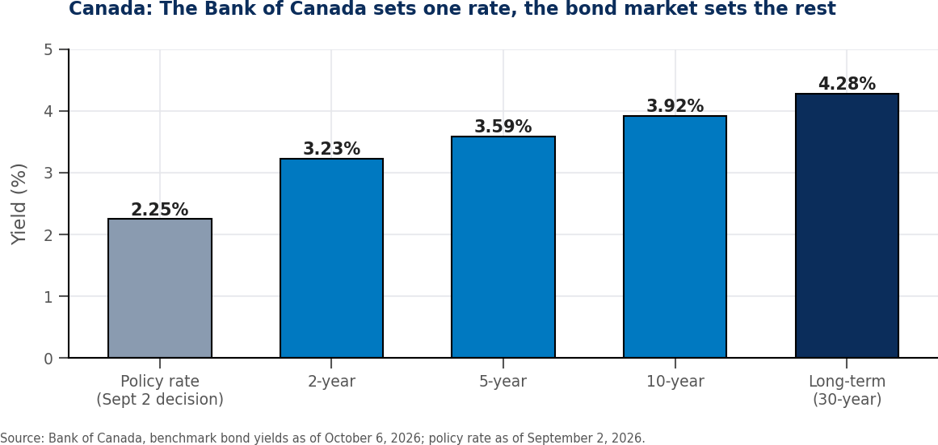
In September, the U.S. Federal Reserve raised its policy rate by a quarter point to a range of 3.75% to 4.00%. It was the Fed's first increase since 2023, and officials signalled that another may follow before year-end.1,2 Around the same time, the yield on the 10-year U.S. Treasury rose above 5%, close to its highest level in more than two decades. In Canada, the Bank of Canada left its policy rate unchanged at 2.25% on September. It also noted that long-term bond yields had moved up around the world, including here at home.
Put simply, the Bank of Canada hasn't tightened, but the bond market has tightened anyway.
Two Different Rates, Two Different Jobs
It helps to separate two numbers that often get lumped together.
The policy rate is set by the central bank. It mainly drives short-term borrowing: the prime rate, variable-rate mortgages, and lines of credit.
A bond yield is the annual return an investor earns for lending money to a government for a set period, such as five or ten years. Yields aren't set by anyone. They're the result of millions of investors deciding, every day, what return they need to lend for that long. When investors worry about inflation, government debt, or uncertainty, they ask for more, and yields go up.
These longer-term yields set the price of much of the economy's long-term borrowing. Five-year fixed mortgage rates in Canada, for example, are priced off the five-year Government of Canada bond yield, not the Bank of Canada's policy rate.
What the Numbers Are Telling Us
The Canadian data show the gap clearly. The Bank of Canada's policy rate was unchanged through September. Over that same month, the five-year Government of Canada yield rose about a third of a percentage point. As of October 6, the five-year yield was 3.59%, compared with 2.75% a year earlier. Canada's 10-year yield was 3.92%, after briefly climbing above 4% in late September, a three-year high.
Three forces are driving this:
It's worth keeping this in perspective. Many bond strategists don't see a fiscal crisis coming, and much of the rise in yields reflects a strong economy rather than distress. Higher yields aren't automatically bad news. They are, however, a change from the decade of very low rates that shaped many financial plans.
The Two Rates at a Glance
Policy Rate (Short-Term) | Bond Yields (Long-Term) | |
Who sets it | The central bank (Bank of Canada, U.S. Federal Reserve) | Investors, through daily buying and selling of government bonds |
How often it changes | At scheduled announcements, eight times a year | Every business day |
What it drives | Prime rate, variable-rate mortgages, lines of credit, HELOCs, savings rates | Fixed-rate mortgages, longer-term business and commercial real estate loans, bond prices, annuity pricing |
What it reflects | Today's inflation and economic conditions | Expectations for inflation, growth, and government borrowing over many years |
Why It Matters Beyond the Bond Market
Bond yields can seem like a concern only for bond investors, but they reach into almost every part of a family's balance sheet.
What This Means for You
The Bottom Line
Central bank decisions will keep making headlines, and they still matter. But this fall shows that the bond market, not policymakers alone, is setting the cost of long-term money.
Sources
Happenings
In September, Christine, Jordan and Dylan, travelled to Toronto to celebrate the completion of the Associate Professional Sales Program (APSP). The program provided valuable opportunities to strengthen advisory, leadership, and relationship-building skills while connecting with colleagues from across the country. Pictured here, They enjoyed an evening at Canoe, taking in the downtown Toronto skyline and reflecting on a rewarding and impactful learning experience.


PLUS I have saved a photo of Kase downshill mountain biking that can be used with a line that he has decided to take on yet another high risk sport to compliment his skiing. We already have a big knee injury which is posing some challenges in his role as a hockey goaltender. But hey… interests will stay with him for a lifetime. I don’t know if he will be putting on tackle pads and playing football when he is 50 but I can count on him heading out for a day on the mountain solo to clear his mind.

Ryan had a busy and exciting summer as he and his wife welcomed their third daughter to the family. Baby Remi was born in June and has settled in perfectly alongside her two proud older sisters, Aanya and Reyna.

With the family now back into their regular routine, activities are once again in full swing. The girls spent much of the summer enjoying soccer, exploring Science World, and trying new experiences as they continue to discover their interests and passions.

Professionally, Ryan jumped right back into the swing of things, partnering with our retail banking colleagues at the BMO Semiahmoo branch to host an Estate Planning Seminar for local clients and community members. The event was a tremendous success, drawing more than 75 attendees who were eager to learn about the importance of proper estate documentation and strategies for transferring wealth efficiently to future generations. The strong turnout reflected the growing interest in proactive estate planning and sparked many meaningful conversations with attendees following the presentation.

This summer, Jordan enjoyed a memorable cruise through Canada’s East Coast and the Maritimes, exploring charming coastal communities and taking in the region’s stunning ocean views. While the scenery and hospitality were unforgettable, the clear highlight of the trip was indulging in some of the Maritimes’ most famous lobster rolls, a local favourite that certainly lived up to its reputation. The journey was a wonderful opportunity to relax, recharge, and experience the best of Atlantic Canada.

Dylan recently travelled to South America for a family friend's wedding in Brazil, and he decided to turn it into a proper trip. He started in São Paulo, one of the largest cities in the world, where he took in its museums and vibrant culture. A highlight was the city's famous churrascarias, the all-you-can-eat Brazilian steakhouses, which he says lived up to the hype.
From there, he headed to Rio de Janeiro and saw Christ the Redeemer, one of the New Seven Wonders of the World.
Dylan sorts his travels into two categories: places he's glad he's been, and places he'd go back to. Rio is firmly in the second group, and he's already hoping to return one day.